If you’re a man focused on becoming The Better Man, you’ve likely been conditioned to believe that transformation requires massive, earth-shattering action. You think you need intense motivation and iron willpower to achieve lasting results.
But the truth, proven by maths and elite performance science, is the opposite: success is not built on heroic leaps; it is constructed through the quiet, consistent accumulation of self discipline habits that compound over time.
The secret to unstoppable success isn’t achieving a big goal; it’s mastering the process of continuous improvement.
Table of Contents
——————————————————————————–
The Core Idea: The Mathematics of Compounding Self Discipline
The average guy often overestimates what he can achieve in a single day and tragically underestimates what he can achieve over a year. When you commit to getting just slightly better every day, you unlock the powerful, predictable geometry of exponential growth. This is the 1% Rule, rooted in the principle of compound interest applied to your abilities.
Here is the simple, game-changing calculation:
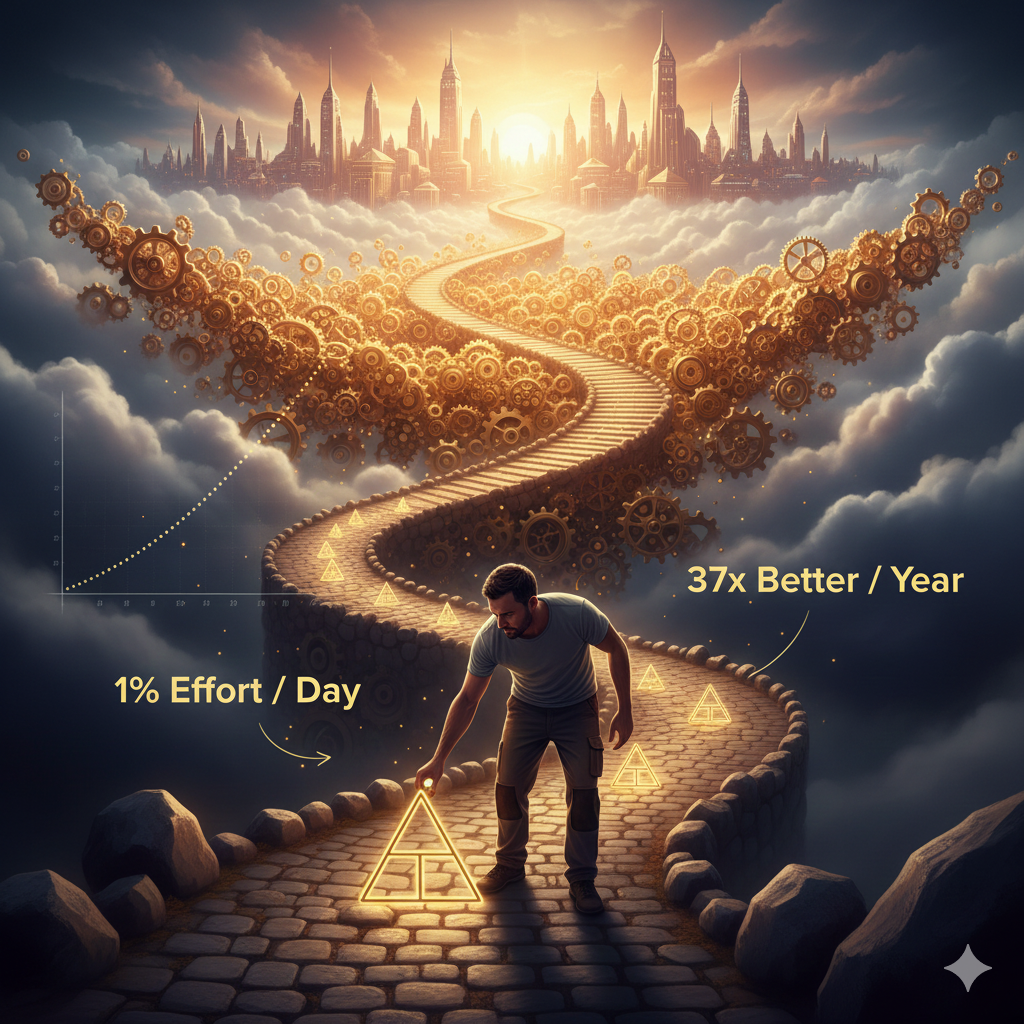
If you manage to get one per cent better each day for one year, you will end up THIRTY-SEVEN times better by the time the year is done.
The compounding formula (1.01365≈37.78) demonstrates that minor improvements, though insignificant on their own, collectively change your entire trajectory.
Conversely, if you allow yourself to get 1% worse each day, you’ll decline nearly down to zero. This proves that small choices don’t make much of a difference today, but they add up to massive changes over the long term, whether positive or toxic.
You do not need to start by taking big actions to make big changes. You just need to commit to making small actions consistently.
——————————————————————————–
The Origin Anecdote: The Unstoppable Power of Marginal Gains
The best proof that the 1% Rule works comes from the world of elite athletics: British Cycling.
Before 2003, professional cycling in Great Britain was defined by nearly a century of mediocrity, having won only a single Olympic gold medal since 1908 and zero Tour de France titles in 110 years. Their performance was so poor that a top European bike manufacturer even refused to sell them equipment, fearing it would damage their brand reputation.
The organisation hired Sir Dave Brailsford, who introduced the philosophy of “the aggregation of marginal gains”. Brailsford’s belief was simple: break down every single component that goes into riding a bike, and then improve each component by just 1 per cent. The cumulative effect would be remarkable.
The team implemented the obvious improvements first, like redesigned bike seats and using biofeedback sensors. But their genius lay in searching for marginal gains in overlooked areas, treating foundational inputs like energy and health as performance multipliers.
Here are the most memorable 1% improvements they leveraged:
• Sleep Optimisation: They researched the precise pillow and mattress that led to the best quality sleep for each individual rider and then travelled with them to every hotel during races.
• Health Protocol: They hired a surgeon to teach the riders the best technique to wash their hands to minimise the chances of catching a cold, thus reducing lost training days.
• Environment Auditing: They even painted the inside of the team truck white to make dust particles easier to spot and remove, ensuring the finely tuned bikes maintained peak performance.
The results were astonishing: within five years of implementing these tiny, disciplined changes, British Cycling dominated the 2008 Beijing Olympics, winning 60 percent of the available gold medals. In 2012, they repeated the feat in London, setting nine Olympic records and seven world records. That same year, a British cyclist won the Tour de France for the first time ever. This historic success confirms that focusing on evolutionary, not revolutionary, change is the superior strategy for sustainable performance.
——————————————————————————–
The Discipline Shift: Why Systems Beat Motivation (The Actionable Step)
If you rely on motivation to achieve your goals, you are relying on an engine that inevitably runs out of fuel. Neuroscience shows that relying solely on willpower is unsustainable because willpower, like a muscle, becomes fatigued. True discipline is not an iron will that forces behaviour; it is the intelligent design of systems that minimises the need for willpower.
The path to unstoppable discipline requires a strategic shift: move your focus from the outcome (the goal) to the process (the system of daily habits).
Every small action you execute under the 1% Rule is a “vote” for the type of man you wish to become. You are not someone trying to get fit; you are embodying the identity of an athlete each time you start a workout.
Actionable Step: Implement Habit Stacking Today
One of the most powerful techniques for easily introducing a 1% improvement into your routine is habit stacking. This technique reduces the mental energy required to initiate new behaviour by leveraging existing neural pathways.
Habit stacking works by attaching a new, desired behaviour (the 1% gain) to an established habit you already perform daily.
The Habit Stacking Formula:
You must be specific and intentional when you define your new habit:
——————————————————————————–
After/before [Current Habit], I will [New Habit].
——————————————————————————–
Key Implementation Principles:
1. Start Ridiculously Small: When establishing a new habit, make it so small it seems trivial, reducing resistance and making failure almost impossible. For instance, if you want to read more, start with reading just one page.
2. Make it Obvious: Habit stacking makes the trigger for your new behavior obvious, which is critical for consistent execution.
Examples for The Better Man Project:
• For Discipline/Productivity: Instead of attempting to overhaul your workspace, try: After I send my last email of the day, I will spend 10 minutes organising my emails/workspace.
• For Physical Health:Before I drink my morning coffee, I will drink a glass of water. Or, if your goal is movement: after I get home from work, I will immediately do two minutes of stretching.
• For Skill Acquisition:After I sit down for lunch, I will read one page of a complex book.
Commit to establishing consistency in these small votes. The magic isn’t in the momentary burst of effort; it’s in the mundane repetition of beneficial behaviours that compound over time, making you nearly 38 times better than the man you were a year ago.
——————————————————————————–
The compounding effect of discipline is like a massive flywheel: it takes tremendous initial effort to get it moving, but once consistent, every small push adds exponential, unstoppable momentum.
Read our latest article about how to control your anger. Read More
I’ve personally suggest visiting and read at James Clear about how to get better habits at https://jamesclear.com
Leave a Reply