The Willpower Trap
Every guy who’s tried to quit something knows the feeling. You white-knuckle it for three days. Maybe a week. You’re using sheer force of will to resist the urge. You tell yourself “just don’t do it” â whatever “it” is. Smoking. Late-night snacking. Endless scrolling. Porn. Drinking on weeknights.
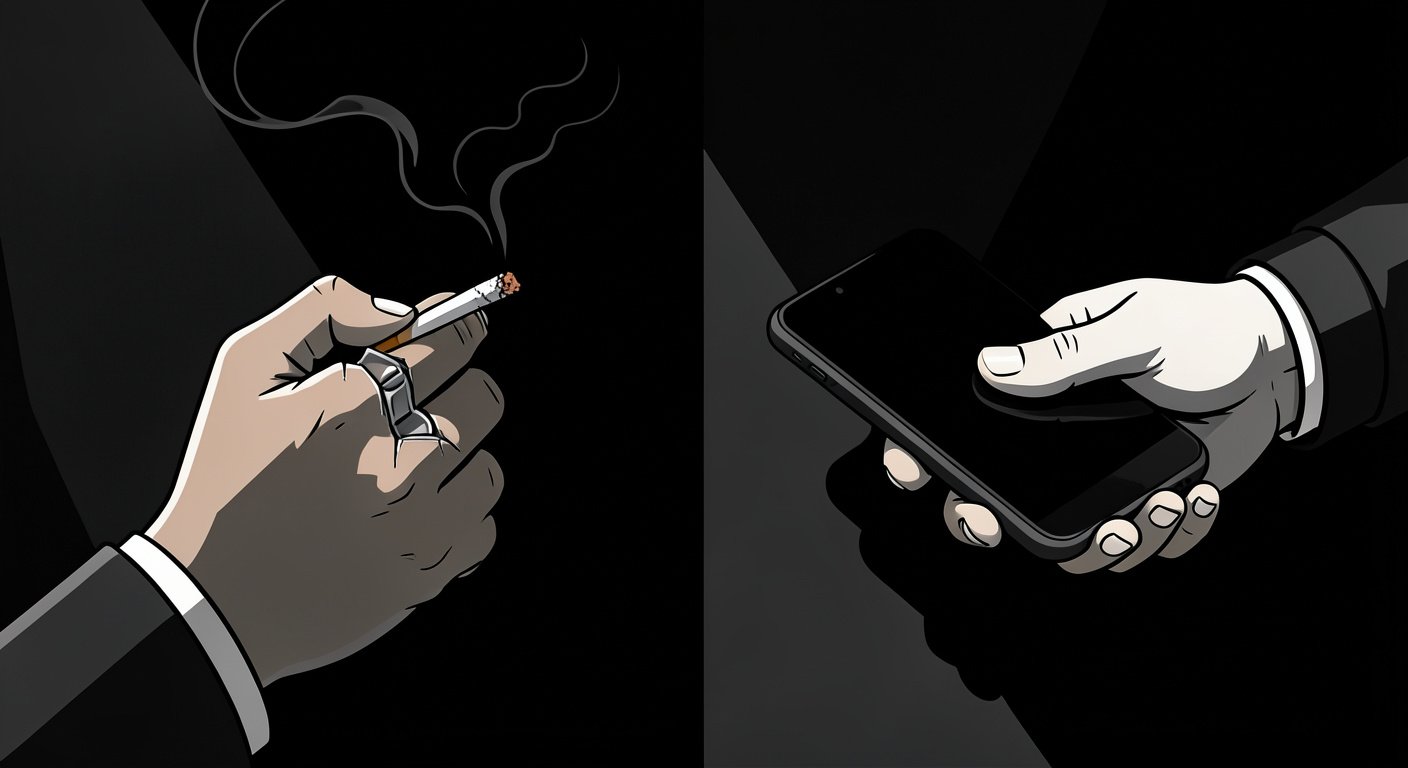
Then life happens. You have a stressful day at work. Your girlfriend starts an argument. You’re tired, you’re drained, and suddenly the thing you were resisting becomes irresistible. You cave. And the worst part isn’t the relapse â it’s the story you tell yourself afterward: “I have no discipline. I’m weak. I’ll never change.”
Here’s what nobody teaches men about breaking bad habits: willpower is not the solution. It’s the problem.
The men who successfully quit bad habits aren’t the ones with iron willpower. They’re the ones who stopped relying on willpower entirely.
Understanding the Habit Loop
Before you can break a bad habit, you need to understand what you’re actually dealing with. Habits aren’t just “things you do.” They’re neurological loops that have been reinforced through repetition until they become automatic.
Charles Duhigg, in The Power of Habit, broke this loop into three parts:
The Cue: The trigger that initiates the behavior. It could be a time of day (9 PM), an emotional state (boredom, stress, loneliness), a location (your couch), or a preceding action (finishing dinner).
The Routine: The behavior itself â the cigarette, the bag of chips, the Instagram scroll, the porn site.
The Reward: What you actually get from the behavior. This is almost never what you think it is. You don’t smoke because you love nicotine â you smoke because it gives you a 5-minute break from stress. You don’t scroll Instagram because the content is interesting â you scroll because it numbs boredom.
The cue and the reward are the bookends. The routine is what you see, but it’s not what’s driving the behavior. Most guys try to attack the routine directly. “Just stop.” That’s like trying to stop a river by punching the water.

Why “Just Stop” Never Works
When you try to eliminate a habit through willpower alone, you’re fighting against a neurological pathway that’s been reinforced hundreds or thousands of times. That pathway doesn’t disappear just because you want it to. It’s like a well-worn trail in a forest â even if you stop using it, the path is still there, waiting for you to walk it again.
This is why relapse rates for most behavior changes are so high. The American Psychological Association reports that willpower-based approaches to behavior change fail in the vast majority of cases. It’s not a character flaw. It’s biology.
Your brain is literally wired to seek the most efficient path. The old habit is a superhighway. The new behavior you’re trying to build is a dirt road through thick brush. Of course your brain takes the highway.
The answer isn’t to try harder. The answer is to build a new road.
The Replacement Method: How It Actually Works
The replacement method is based on a simple principle: you cannot eliminate a habit. You can only replace it.
This isn’t motivational fluff. It’s how the brain works. When a cue fires, your brain expects a reward. If you simply refuse to do the old routine, your brain is left hanging â cue, no routine, no reward. That creates a craving that builds until you break.
The replacement method keeps the cue and the reward but swaps out the routine. Same trigger. Same payoff. Different action.
Here’s how to do it step by step:
Step 1: Identify the Real Cue and Reward
Write down every time you engage in the habit you want to break for one week. Note: time, location, emotional state, who you’re with, and what you just did.
Patterns will emerge. Maybe you always smoke after eating. Maybe you binge-eat sugar when you’re alone at night. Maybe you open porn when you’re bored at 2 PM.
Then ask yourself: what’s the actual reward? Not the superficial one. Are you chasing relaxation? A dopamine hit? Escape from boredom? Social connection? A feeling of control?
This step is uncomfortable. It requires brutal honesty. But you can’t replace something until you understand what it’s actually giving you.
Step 2: Choose a Replacement That Delivers the Same Reward
If you stress-eat at night, the reward might be comfort and oral stimulation. Replacements: sugar-free gum, hot herbal tea, or crunching on carrots with salsa. Same sensation. Different outcome.
If you doom-scroll social media when bored, the reward is mental stimulation. Replacements: a Kindle app on your phone, a podcast, Duolingo, or even a mobile game that requires actual thought.
If you drink on weeknights to unwind, the reward is relaxation and transition from work mode. Replacements: a non-alcoholic beer (same ritual, no alcohol), a 20-minute walk, or a hot shower.
If you smoke for the break from work, the reward is stepping away from stress. Replacements: stepping outside for 5 minutes of deep breathing, chewing sunflower seeds, or calling a friend.
The replacement must deliver the same category of reward. If it doesn’t, your brain will reject it and return to the old behavior.
Step 3: Make the Old Habit Hard and the New Habit Easy
This is where environment design beats willpower. Don’t try to resist temptation â remove it.
For each bad habit, add friction: delete the apps, throw out the junk food, put the cigarettes somewhere inconvenient, install a website blocker, keep your phone in another room after 9 PM. Make the bad habit require effort.
For each replacement, remove friction: pre-load the Kindle app, keep gum in your car and at your desk, set out your walking shoes by the door, have the herbal tea ready to brew. Make the new habit the path of least resistance.
Behavioral economists call this “choice architecture.” You’re not relying on being strong in the moment â you’re designing your environment so the right choice is the easy choice.
Step 4: Plan for Failure
You will slip. That’s not pessimism â it’s reality. The difference between men who succeed and men who stay stuck isn’t whether they slip. It’s what happens next.
Create an “if-then” plan for when you relapse. “If I eat junk food tonight, then tomorrow morning I’ll go for a 30-minute walk and eat a high-protein breakfast.” “If I smoke a cigarette, then I’ll immediately throw away the rest of the pack and do 20 pushups.”
These plans prevent the “what-the-hell effect” â the psychological spiral where one slip becomes a full relapse because you’ve already “ruined” everything. You haven’t ruined anything. You had one bad moment. Move on immediately.
Why Replacement Works Where Willpower Fails
The replacement method works because it respects how your brain actually operates. You’re not trying to delete a neural pathway â you’re building a competing one. Over time, with repetition, the new pathway becomes stronger than the old one.
Neuroscientists call this “synaptic pruning” â connections you use get stronger, connections you don’t use get weaker. Every time you respond to the cue with the replacement instead of the old habit, you’re physically rewiring your brain.
Willpower is a battering ram against a brick wall. Replacement is building a door.

The Bottom Line
You are not weak because you can’t quit through willpower alone. The game was rigged from the start. The men who successfully break bad habits aren’t superheroes â they’re just guys who learned to work with their biology instead of fighting it.
Identify the cue. Understand the real reward. Swap the routine. Make the right choice easy and the wrong choice hard. Plan your comeback before you even slip.
Stop trying to be stronger than your habits. Start being smarter than them.
Comments are closed.