
Emotional control is the defining skill that separates mature men from reactive boys. Real strength isn’t about suppressing what you feel — it’s about mastering your response. This guide from The Better Man Project teaches you exactly how to build the emotional discipline that earns respect.
Emotional control isn’t about becoming numb. It’s not about shoving feelings down and pretending they don’t exist. That’s the boy’s way.
The man’s way is different. Real men feel everything. Rage, grief, fear, joy, but they refuse to be hijacked by those feelings. They’ve built the space between what happens to them and how they respond. And in that space lives every quality you actually want: patience under pressure, calm during chaos, the ability to lead when everyone else is panicking.
Here’s what most people don’t realize: emotional intelligence predicts success in life and work more reliably than IQ does. Studies show that IQ accounts for roughly 25% of career success. Emotional intelligence. Your ability to recognize, understand, and manage emotions. Is the critical differentiator that fills the rest. Employers know this too. A 2019 survey found that 59% of employers would not hire someone with low emotional intelligence even if they had a high IQ.
This isn’t soft skills talk. This is the difference between a man who loses his job because he couldn’t control his temper, and a man who gets promoted because he stayed steady when everything fell apart. It’s the difference between a father his kids trust and a father his kids walk on eggshells around.
Emotional control is a buildable skill. Not a personality trait you’re born with or without. And this article will show you exactly how to build it.
The Real Problem

We were given two broken options. Option one: stuff everything down until you explode. Option two: let every feeling run the show.
Neither one works. And most guys bounce between both. Bottling it all week, then losing it over something small on Saturday.
The real problem runs deeper than the outburst. The real problem is that many men can’t even name what they’re feeling. Psychologists call this “emotional granularity”. The ability to identify and label your emotions with precision. Research shows that people with high emotional granularity regulate themselves better and make sharper decisions under stress.
Ask a struggling man what he feels and you’ll get one of three answers: “fine,” “angry,” or “stressed.” That’s not self-awareness. That’s a vocabulary of three words for an emotional spectrum that contains hundreds.
When you can’t name it, you can’t manage it. The feeling owns you because you don’t even know what you’re fighting.This isn’t your fault. Most of us grew up in environments where “man up” was the entire emotional education curriculum. Boys who cried were told to toughen up. Boys who showed fear were called weak. The message landed hard and early: feelings are a liability. So we learned to bypass them, and spent years wondering why we kept crashing.
The Hard Truth
Suppressing your emotions doesn’t make them disappear. It makes them stronger.Neuroscientists call this an “amygdala hijack.” The term was coined by psychologist Daniel Goleman, and it describes exactly what it sounds like. Your emotional brain takes over and your rational brain gets shoved offline. In that moment, you’re not you. You’re a biological threat response wearing a man’s body.
The scary part? The hijack happens in milliseconds. Faster than conscious thought.
So when you “stay calm” by stuffing everything down, you’re not actually calm. You’re a pressure cooker with the valve welded shut. The explosion is coming. It’s just a question of when and who’s standing closest.
Here’s the harder truth: nobody cares about your reasons.Your boss doesn’t care that you were “provoked.” Your girlfriend doesn’t care that you “couldn’t help it.” Your kids don’t care that you “had a rough day.” The world judges you by your response, not your stimulus.
A boy reacts and hopes people understand why. A man responds and doesn’t need excuses.
The data backs this up. Men who score low on emotional regulation report lower relationship satisfaction, earn less over their careers, and experience more health problems. Including cardiovascular issues directly linked to chronic anger and stress. Emotional dysregulation has a body count.
What To Do Instead
Stop trying to control your emotions. Start controlling the space between the emotion and the action.Viktor Frankl, a psychiatrist who survived Auschwitz, wrote the most important sentence ever written about emotional control:
> “Between stimulus and response there is a space. In that space is our power to choose our response. In our response lies our growth and our freedom.”
That space is the whole game. Everything that follows is about widening it.
The goal is not to feel less. The goal is to feel fully. Anger, sadness, fear, desire, and still choose your action. The emotion becomes information, not a command. It tells you something about what’s happening. It does not get to drive.
This is the shift from boy to man. A boy is a puppet to his feelings. A man feels the strings but holds his own hands.Practical emotional control looks like this: you’re in a meeting and someone undermines you publicly. The anger surges. That’s normal, that’s human. Your amygdala fires. Your chest tightens. But instead of firing back or sitting there silently fuming, you notice the sensation. You name it: “I’m feeling disrespected and angry right now.” And then you choose. Maybe you address it calmly after the meeting. Maybe you let it go because the battle isn’t worth it. Either way, you chose. The anger didn’t choose for you.
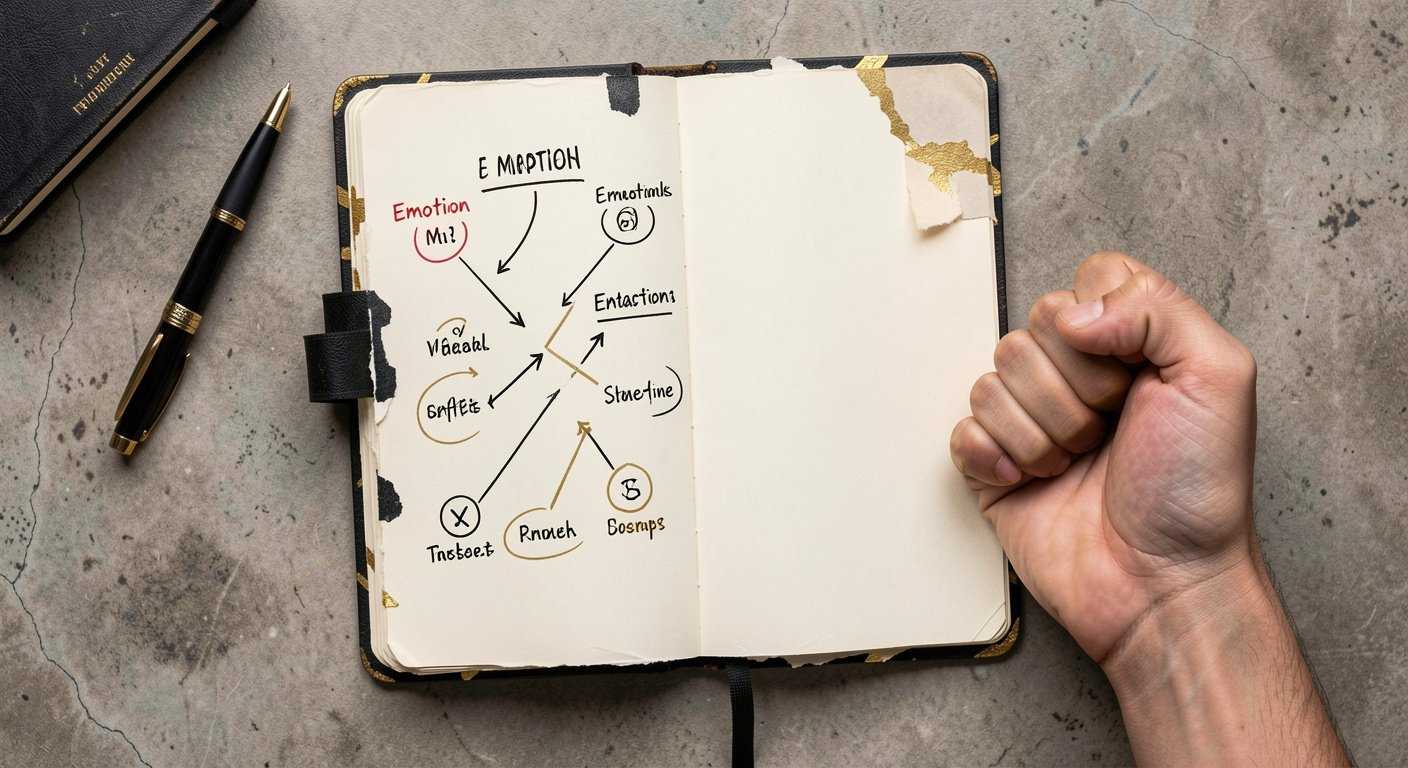
Step 1: Build Your Emotion Vocabulary
You can’t control what you can’t name. Most men operate with three emotional words. You need more.
Start here: the next time you feel something strong, write down the physical sensations first. Tight chest. Hot face. Clenched jaw. Then attach a precise word. Not “angry”. Maybe “humiliated,” “dismissed,” or “betrayed.” Not “stressed”. Maybe “overwhelmed,” “pressured,” or “underprepared.”
Specificity is the first tool of control. When you can say “I feel disrespected because my work was ignored,” you’ve already shrunk the feeling down to size. It’s no longer a shapeless storm. It’s a named problem with a source.Step 2: Use the 10-Second Rule
When you feel the heat rising. The argument, the email, the traffic. Delay your response by ten seconds.
Ten seconds. Not forever. Not “never react.” Just ten seconds of silence between the stimulus and whatever comes next.
During those ten seconds, breathe. Slow, deliberate inhale through the nose, longer exhale through the mouth. This physically activates your parasympathetic nervous system. The body’s built-in calm-down switch. It tells your amygdala: “We’re not under attack. Stand down.”
The first few times you try this, you’ll probably still react badly. That’s fine. The point is that you started noticing the space. Next time, the space gets wider.
Step 3: Name It Before You Act On It
A simple script: “I’m feeling [emotion] because [reason]. What I actually want here is [outcome].”
Say it silently to yourself. Say it in your head before you open your mouth.
“I’m feeling defensive because my competence was questioned. What I actually want here is to address the concern without looking weak.”
Now you’re not just reacting. You’re problem-solving.
Step 4: Practice Cold Exposure. Literally

This sounds unrelated. It’s not.
Cold showers train the exact neural pathway you need for emotional control. When freezing water hits your skin, your body screams at you to get out. Your amygdala is lighting up like a fire alarm. But you stay. You breathe through the discomfort. You teach your brain: “The alarm is loud, but I’m still in charge.”
Voluntary discomfort builds the pause muscle. Thirty seconds of cold at the end of your shower, every day. It’s the simplest emotional control workout you’ll ever do.Step 5: Review Your Reactions Weekly
Once a week, spend five minutes reviewing the moments you lost control. Or almost did. What triggered you? What did you feel? What did you do? What would you do differently?
This is not self-punishment. This is calibration. You’re not judging yourself. You’re training yourself. Fighters watch tape. So do emotionally disciplined men.
Common Mistakes
Mistake 1: Confusing Suppression With Control
Pushing a feeling down and calling it discipline is like locking a wild animal in a closet and calling it tamed. The animal is still in there. It’s getting bigger. And eventually, it’s coming through the door.
Real control is processing, not repressing. You acknowledge the emotion. You let it exist. You just don’t let it drive.The men who seem the calmest aren’t the ones who feel nothing. They’re the ones who’ve learned to co-exist with intense feelings without being ruled by them.
Mistake 2: Thinking Emotional Control Means Being Cold
The goal is not to become a robot. The cold, detached “sigma male” aesthetic is just another form of suppression wearing a different outfit.
Strength is feeling everything and still choosing your response. The father who cries at his daughter’s wedding is not weak. The man who feels grief fully and still gets out of bed the next morning is not broken. He’s demonstrating the highest form of emotional control. Depth without drowning.Mistake 3: Apologizing Instead of Adjusting
“I’m sorry, I just lost my temper” is not emotional control. It’s emotional control’s apology tour. And after the third or fourth tour, the apology stops meaning anything to the people who have to hear it.
Apologize once, then change the behavior. If you keep losing your temper in the same situations, the apology is a ritual, not a repair. The real apology is becoming harder to provoke.For the next seven days, do this:
Every time you feel a strong emotion. Anger, frustration, jealousy, anxiety. Do not act on it for sixty seconds.Sixty seconds. One minute. During that minute, name the emotion specifically. Identify what triggered it. Breathe five slow inhales and exhales. Then decide what you’re going to do. Not what the emotion wants you to do, but what you, the man in control, choose to do.
Track it. Write down each time you succeeded and each time you slipped. No judgment on the slips. Just data. By day seven, you’ll have a map of your emotional triggers and a growing stack of evidence that you are not, in fact, a hostage to your feelings.
This is how the skill is built. Not by reading about it. By practicing it under live fire.
Final Thought
Emotional control is not about becoming less human. It’s about becoming more dangerous to the things that used to control you.Every man who ever lost a job, a relationship, or his own self-respect because of an emotional reaction he couldn’t take back. That man wasn’t weak. He was untrained. And training is available to everyone who wants it.
The space between stimulus and response starts out thin as a blade. With practice, it becomes a field. Wide enough to walk through. Wide enough to choose. Wide enough to build a life on.
A boy lets his feelings drive. A man takes the wheel.FAQ
Q: Isn’t emotional control just another way of saying “bottle it up”?No. Bottling it up means refusing to acknowledge the emotion at all. Emotional control means acknowledging the emotion fully, feeling it completely, and then choosing your response deliberately. The difference is awareness. Suppression is unconscious avoidance. Control is conscious choice.
Q: What if I’ve been emotionally reactive my whole life. Is it too late to change?It’s never too late. The brain remains capable of rewiring itself throughout adulthood. A process called neuroplasticity. Every time you pause instead of react, you’re strengthening the neural pathway between your prefrontal cortex and your amygdala. You’re literally changing the physical structure of your brain. The phrase “you can’t teach an old dog new tricks” is biologically false. You can. It just takes practice.
Q: How do I stay emotionally controlled when someone is deliberately provoking me?The provocation is their choice. Your reaction is yours. When someone deliberately pushes your buttons, they may be hoping for a fast reaction. A ten-second pause can give you time to choose a more useful response. In those ten seconds, ask yourself: “What do they want me to do right now? And do I want to give them that satisfaction?” Most of the time, the answer to the second question is no. Staying calm when someone is trying to rattle you is one of the most powerful positions a man can occupy. It communicates strength without a single aggressive word.
If this helped you, send it to a man who needs to learn that strength isn’t about feeling nothing. It’s about feeling everything and still choosing who you want to be.- Continue Building:
- Calm Under Pressure: Emotional Control Most Men Never Learned
- Stop Reacting: 3 Steps to Master Your Anger Like a Man, Not a Boy
- Stoicism Isn’t About Feeling Nothing — It’s About Mastering What You Feel
- Why Keeping Your Word Is the Foundation of Self-Respect
- How to Build Mental Toughness for Men: Seven Practical Skills
Comments are closed.