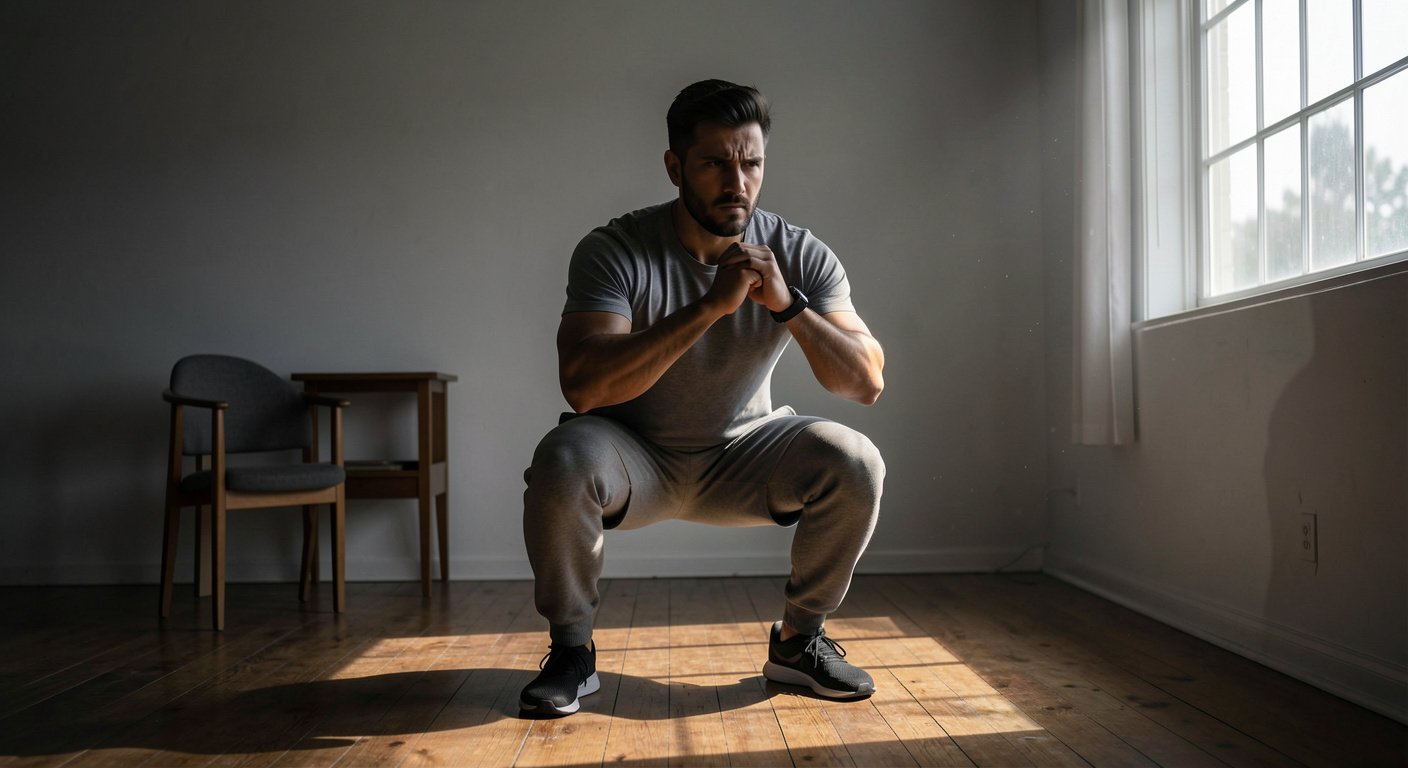
A 20-minute bodyweight workout. Done consistently. Builds real strength, improves posture, and sharpens mental discipline. No gym, no equipment, no excuses. This is the push/pull/legs/core circuit that actually works when you apply progressive overload.
FIELD NOTE
A 20-minute bodyweight workout. Done consistently. Builds real strength, improves posture, and sharpens mental discipline. No gym, no equipment, no excuses. This is the push/pull/legs/core circuit that actually works when you apply progressive overload.
If fat loss is your main goal, use this workout to support muscle and consistency while nutrition creates the energy deficit. The complete weight-loss plan for men shows how to combine strength work, walking, protein, and calories without crash dieting.
The Real Problem
Most men know they should work out. They’ve downloaded the apps. They’ve watched the YouTube videos. They’ve even bought the gym membership they haven’t used in three months.
But something doesn’t click.
The problem isn’t laziness. The problem is friction. Between the desk job, the commute, and the couch, your environment wants you motionless. When you think about working out, your brain runs the math: drive to the gym, change, figure out which machine does what, feel awkward around guys who know what they’re doing. That’s not laziness. That’s a rational response to too many barriers.
The real trap is believing that if it’s not heavy barbell training in a proper gym, it doesn’t count.
The Hard Truth
Your body doesn’t know the difference between a barbell and the floor. It only knows tension, effort, and fatigue. A 2019 study found that after four weeks of strength training, the nervous system becomes significantly better at activating muscle fibers. Weights or bodyweight, same adaptation. A Journal of Strength and Conditioning Research study compared progressive push-up training to barbell bench press. Both groups saw comparable upper-body strength gains.
You’re not avoiding results by skipping the gym. You’re avoiding results by skipping the work.
A 2024 trial confirmed that progressive overload. Heavier loads or more repetitions. Produces equal gains in strength and muscle size over 10 weeks.
What To Do Instead
1. Master the Push/Pull/Legs/Core Split
Forget random circuits. Organize your 20 minutes into four 5-minute blocks: push, pull, legs, core. This balances development and prevents the posture problems that come from only doing push-ups.
Push: Standard push-ups, diamond push-ups, or decline push-ups (feet elevated). Pull: Doorway rows, inverted rows under a sturdy table, or resistance band pull-aparts if you have one. Legs: Bodyweight squats, Bulgarian split squats, walking lunges. Core: Planks, dead bugs, lying leg raises.
2. Apply Progressive Overload Without Weights
Most men stall with bodyweight training because they do the same thing every session. Your muscles adapt. Here’s how to keep progression going:
Add reps: If you did 12 push-ups last session, aim for 13 today.
Slow the tempo: Use a 3-1-3 cadence. 3 seconds down, 1-second pause, 3 seconds up. Time under tension drives hypertrophy.
Change leverage: Elevate your feet for push-ups. Move to single-leg squats. Shorten rest periods from 60 seconds to 30.
Increase volume: Add one more set per exercise each week until you reach 4 sets per movement.
3. Train With Intention, Not Distraction
Twenty minutes is too short to scroll between sets. Put the phone in another room. Focus on the muscle you’re working. Research shows consciously contracting the target muscle during each rep can increase activation by up to 22%. That’s free gains lost to notifications.
4. Stack It Onto Something You Already Do
The easiest way to miss a workout is to make it a separate event. Attach your 20 minutes to a habit that already exists: right after morning coffee, immediately when you get home from work, or as a transition between work mode and evening. When the workout lives inside a routine you already have, you don’t need motivation. You just need momentum.
MISSION BRIEF
Your body doesn’t know the difference between a barbell and the floor. It only knows tension, effort, and fatigue. A 2019 study found that after four weeks of strength training, the nervous system becomes significantly better at activating muscle fibers. Weights or bodyweight, same adaptation. A Journal of Strength and Conditioning Research study compared progressive push-up training to barbell bench press. Both groups saw comparable upper-body strength gains.
5. Track It or It Didn’t Happen
Write down your numbers. A simple note on your phone works: date, exercises, reps, how it felt. Tracking creates accountability and shows you the upward trend when motivation dips. In 8 weeks, seeing “push-ups: 8 → 22” is better than any pre-workout for getting you on the floor.
SIMPLE ACTION PLAN
Tonight: Clear a 6-foot space on your floor. That’s all the equipment you need.
Tomorrow morning: Do 5 minutes. Just the push and squat blocks. Prove to yourself that starting is the only hard part.
This week: Complete three full 20-minute sessions. Monday, Wednesday, Friday. Rest days in between. Muscles grow when you recover, not when you train.
Track it: Open a note on your phone and write down what you did after every session.
Common Mistakes
Sacrificing form for reps. A push-up where your hips sag and elbows flare to 90 degrees is shoulder damage in the making. Keep your core tight, elbows at 45 degrees. Quality reps build strength; sloppy reps build physiotherapy bills.
Skipping the pull movements. Men love push-ups and ignore pulling. This creates the rounded-shoulder, forward-head posture that screams “I sit at a desk all day.” For every push exercise, match it with a pull.
Doing the same workout every time. Your body adapts quickly. If you’re not tracking and progressing, you’re just burning a few calories, not building strength.
Treating bodyweight training as a warm-up. It’s not a stepping stone to “real” training. When progressed correctly, it IS real training.
BETTER MAN CHALLENGE
This week, complete three 20-minute bodyweight sessions. No gym. No equipment. No music. Just you, the floor, and your breath. Before each session, ask yourself: “Am I doing this because I want to, or because I said I would?”
At week’s end, answer one question: did you hit all three or didn’t you? No explanations.
ACTION PLAN
Final Thought
Strength doesn’t start with a barbell. It starts with the decision to get on the floor when everything wants you on the couch. That decision. Made once, then twice, then enough times it becomes automatic. Is the foundation every other physical discipline is built on. Twenty minutes. Your floor. Right now.
FAQ
Can bodyweight training actually build muscle? Yes. When you apply progressive overload. A 2024 study confirmed that progressing through more repetitions produces muscle hypertrophy equal to progressing through heavier loads. Increase reps, slow tempo, change leverage. Your muscles will adapt and grow.
How do I work my back without equipment? Doorway rows: stand in a doorframe, grip at chest height, lean back, pull yourself forward. Inverted rows under a sturdy table also work. One resistance band covers everything if you have it.
Is 20 minutes really enough? Yes. If intensity is high and consistency is there. Three weekly sessions with proper progression produce measurable results in 8 weeks. The key isn’t duration; it’s effort and regularity.
What if I can’t do a single push-up? Start with incline push-ups against a wall or counter. As they get easier, lower the angle until you reach the floor. Everyone starts somewhere, and the only failed rep is the one you don’t attempt.