You’re not lazy. You’re not undisciplined. You hate the gym. And that’s fine.
Maybe it’s the fluorescent lights. Maybe it’s the guy grunting over the dumbbells like he’s giving birth to a small car. Maybe it’s the 40-minute round trip that kills your momentum before you even walk through the door. Whatever your reason, the gym isn’t working for you. And you don’t need it to.
The best exercise program is the one you actually do. If going to the gym feels like pulling teeth, you won’t go. You’ve proven that already. So let’s stop pretending you’ll wake up tomorrow and suddenly love the gym. Let’s build a home workout for men who hate gyms , a system that works in your living room, your garage, or your bedroom floor. Zero equipment. Zero commute. Zero excuses. This guide covers the best exercises for men who hate the gym , a complete system with zero equipment. If you’re starting from absolute zero, here’s how to start working out when you’ve never trained before.
Exercises for Men Who Hate the Gym: Why It’s OK (You’re Not Lazy, You’re Normal)
You’re not alone in this. Over 40% of people avoid working out because of gym intimidation. The industry even has a name for it: gymtimidation.
Think about what a gym actually demands from you. You drive there. You change clothes. You wait for equipment that someone else is using. You navigate a space filled with people who seem to know exactly what they’re doing while you’re figuring out which way the leg press machine faces. Then you drive back. That’s an hour of overhead for 45 minutes of actual work.
A lot of men internalize this friction as a personal failure. “I’m not disciplined enough for the gym.” No. The gym is a system with high activation energy. You’re not weak. The system is designed for people who already bought in. You need a system designed for someone who hasn’t. That’s what this is.
The Science: Can You Actually Build Muscle Without Weights?
The short answer: yes. The longer answer: research says yes, with conditions that are easy to meet.
A 2017 meta-analysis led by Brad Schoenfeld, published in the Journal of Strength and Conditioning Research, compared low-load resistance training (think bodyweight exercises) with high-load training (think barbells). The finding: both produced similar muscle hypertrophy when sets were taken to failure.
Your muscles respond to tension and fatigue, not the brand name on a dumbbell. Push to the point where you can’t do another rep with good form, and your body builds muscle whether that resistance came from a 200-pound barbell or your own bodyweight.
The benefits stack up quickly. A review published in Current Sports Medicine Reports found that ten weeks of resistance training increased lean body mass by 1.4 kg, boosted resting metabolic rate by 7%, and reduced fat mass by 1.8 kg. That’s a visible physical change in two and a half months, from your living room floor.
For 90% of what men want from exercise. Looking better, feeling stronger, being healthier. Bodyweight training is enough. If your goal is to compete in powerlifting, you’ll need a barbell. If your goal is to get fit without going to the gym and stop hating what you see in the mirror, the floor beneath you is all the equipment you need.
The 5 Essential Exercises Every Home Workout Needs
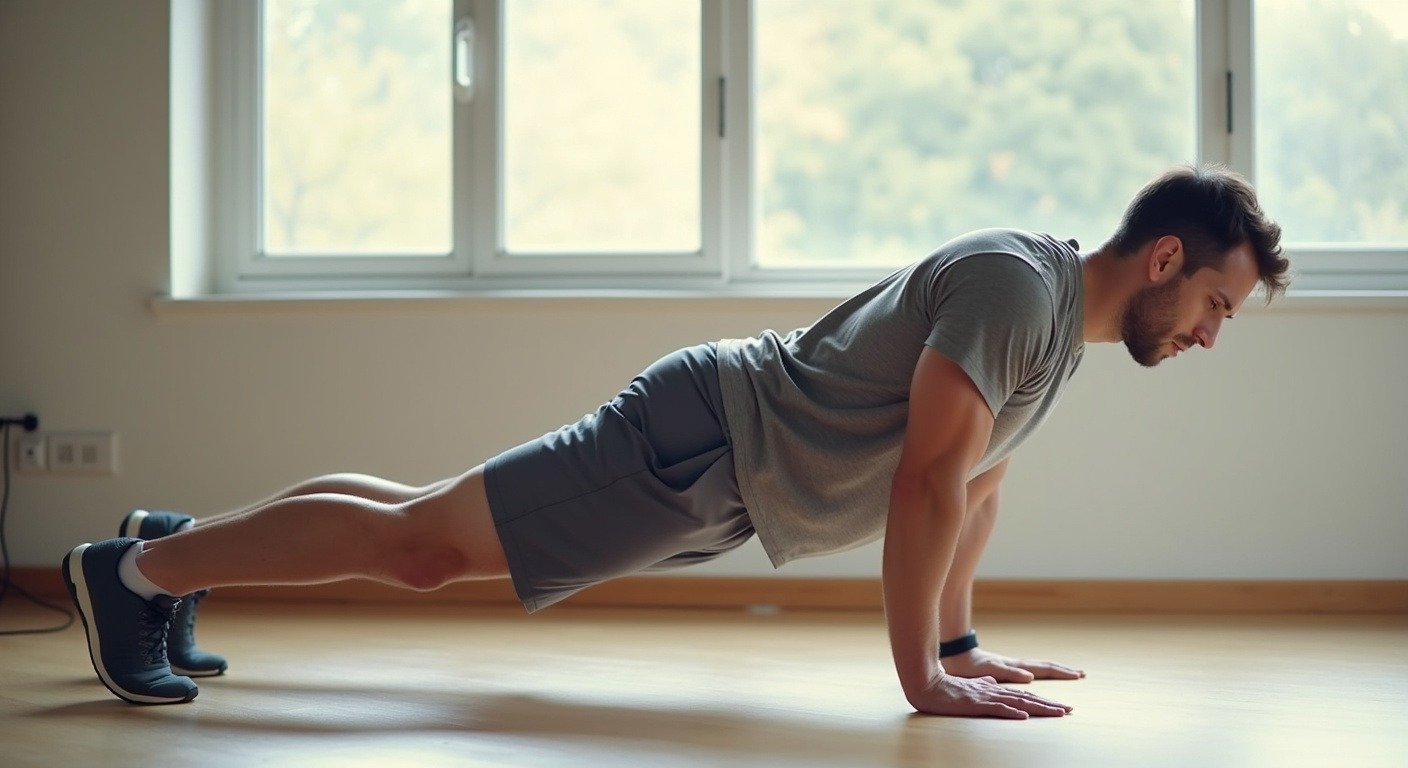

Every effective workout covers five fundamental movement patterns. Think of this as calisthenics for beginners at home , here are the bodyweight versions that hit all of them.
1. Push-Ups (Horizontal Push)
Targets chest, shoulders, and triceps. Hands shoulder-width apart. Body forms a straight line from head to heels. Lower until your chest nearly touches the floor. Push back up explosively.
If standard push-ups are too hard: do them from your knees or against a wall. If they’re too easy: elevate your feet on a chair (decline push-ups).
2. Bodyweight Squats (Knee-Dominant Lower Body)
Targets quads, glutes, and hamstrings. Feet shoulder-width apart, toes slightly out. Keep your chest up and lower until your thighs are parallel to the floor or below. Drive through your heels to stand.
If squats are too hard: squat to a chair and stand back up. If too easy: single-leg squats (pistol squats) or jump squats.
3. Inverted Rows (Horizontal Pull)
Targets back and biceps. You need something to pull against: a sturdy table, a low bar at a playground, or a doorframe pull-up bar set low. Lie underneath, grab the edge, pull your chest to the bar. Keep your body straight.
If rows are too hard: bend your knees, feet flat on the floor (easier angle). If too easy: elevate your feet on a chair.
4. Planks and Leg Raises (Core)
Planks: hold a push-up position on your forearms. Keep your hips level. Don’t let your lower back sag. Build up to 60 seconds.
Leg raises: lie flat on your back, legs straight. Lift them together until they’re vertical, then lower slowly without letting your heels touch the ground.
5. Glute Bridges (Hip Hinge)
Targets glutes and hamstrings. Lie on your back, knees bent, feet flat. Squeeze your glutes and lift your hips until your body forms a straight line from shoulders to knees. Hold for two seconds at the top, then lower.
This exercise counters the damage of sitting all day. Most men have weak glutes and overactive hip flexors. The bridge fixes both.
How to Make Bodyweight Exercises Harder (Progressive Overload Without Weights)
Here’s the problem that kills most home workout routines — and the reason exercises for men who hate the gym need a built-in progression system. You do 20 push-ups, they feel hard for a week, then your body adapts and they feel easy. You keep doing 20 push-ups. Nothing changes. You quit.
Progressive overload is the principle that you must increase the demand on your muscles over time to keep growing. In the gym, you add 5 pounds to the bar. At home, you use these methods:
Add reps. Go from 10 push-ups to 12 to 15 to 20. Once you can do 3 sets of 20 with perfect form, move to the next method.
Reduce rest. Go from 90 seconds between sets to 60 seconds to 45 seconds. Same work in less time is a higher training density.
Slow down the tempo. Take 3-4 seconds to lower yourself during a push-up or squat. The eccentric (lowering) phase causes the most muscle damage, and muscle damage drives growth. Count: “one one thousand, two one thousand, three one thousand” on the way down, then push up normally.
Switch to unilateral versions. One-arm push-ups, single-leg squats, one-arm inverted rows. Unilateral exercises force your smaller stabilizing muscles to work harder and increase the load on the working limb. You don’t need to do full one-arm push-ups immediately. Start with archer push-ups: one arm straight to the side, the other doing most of the work.
Change the leverage. Elevate your feet for push-ups. Elevate your feet for rows. Add a pause at the bottom of squats. Small adjustments in leverage change the resistance curve significantly.
The key is tracking. Write down what you did last session. If you don’t know what you did last time, you can’t overload it this time. A notebook or a notes app. That’s it.
The 3-Day Full Body Routine (No Equipment Required)
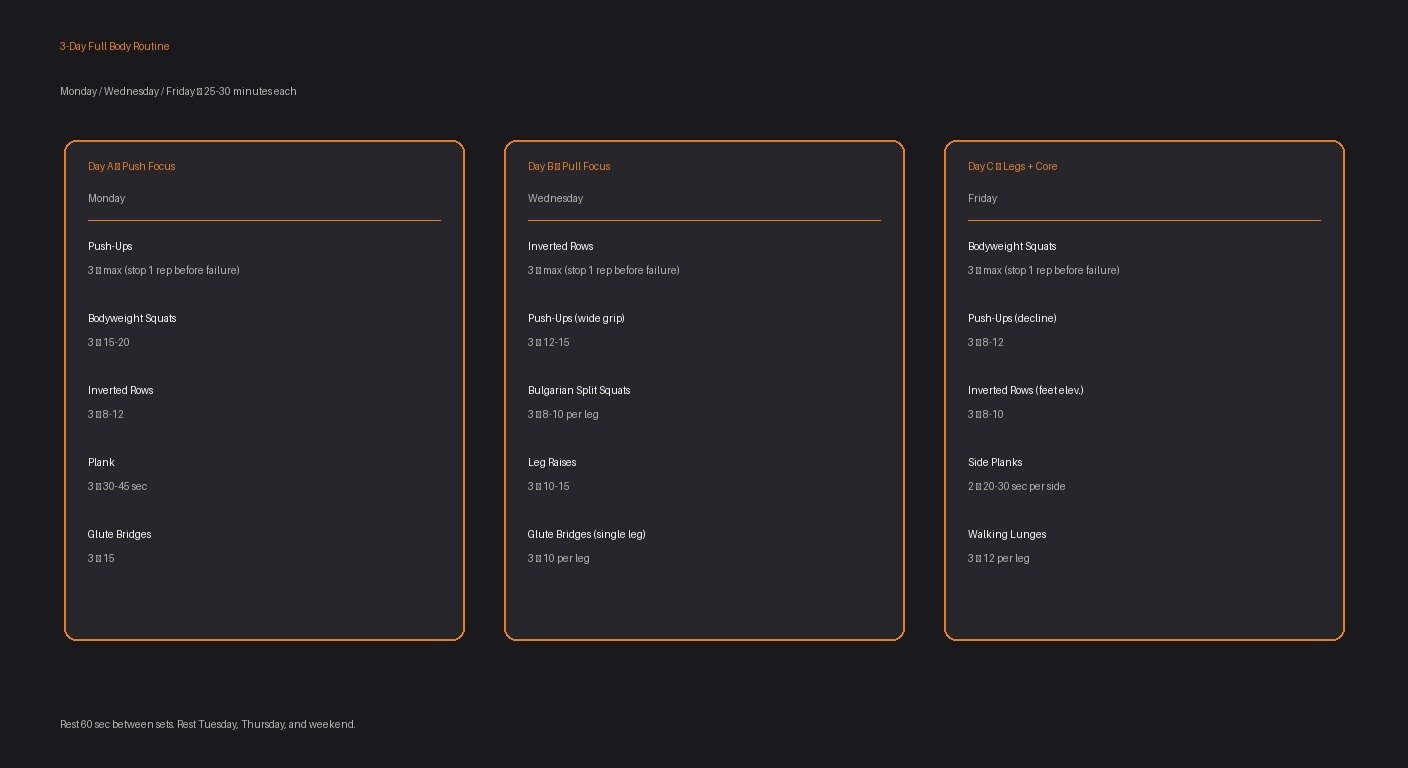
Here is the program , a no equipment workout for men that takes 25 minutes. Monday, Wednesday, Friday. Every session hits your entire body. Rest on Tuesday, Thursday, and the weekend. That’s 48 hours of recovery between sessions and a full weekend to do whatever you want. If you only have 20 minutes some days, this 20-minute bodyweight workout covers the same movements in half the time.
Day A , Push Focus (Monday)
| Exercise | Sets × Reps | Rest |
|---|---|---|
| Push-Ups | 3 × as many as possible (stop 1 rep before failure) | 60 sec |
| Bodyweight Squats | 3 × 15-20 | 60 sec |
| Inverted Rows | 3 × 8-12 | 60 sec |
| Plank | 3 × 30-45 sec hold | 45 sec |
| Glute Bridges | 3 × 15 | 60 sec |
Day B , Pull Focus (Wednesday)
| Exercise | Sets × Reps | Rest |
|---|---|---|
| Inverted Rows | 3 × as many as possible (stop 1 rep before failure) | 60 sec |
| Push-Ups (wide grip) | 3 × 12-15 | 60 sec |
| Bulgarian Split Squats | 3 × 8-10 per leg | 60 sec |
| Leg Raises | 3 × 10-15 | 45 sec |
| Glute Bridges (single leg) | 3 × 10 per leg | 60 sec |
Day C , Legs + Core (Friday)
| Exercise | Sets × Reps | Rest |
|---|---|---|
| Bodyweight Squats | 3 × as many as possible (stop 1 rep before failure) | 60 sec |
| Push-Ups (decline) | 3 × 8-12 | 60 sec |
| Inverted Rows (feet elevated) | 3 × 8-10 | 60 sec |
| Side Planks | 2 × 20-30 sec per side | 45 sec |
| Walking Lunges | 3 × 12 per leg | 60 sec |
All three sessions take about 25-30 minutes. Do them in the morning before your brain has time to negotiate with itself. Roll out of bed. Hit the floor. Done before your coffee gets cold.
What to Do When Bodyweight Gets Too Easy
The program above has built-in progression. Each day, you push to “one rep before failure.” As you get stronger, that number goes up naturally. When the base versions feel easy, level up:
| Exercise | Easier | Standard | Harder | Hardest |
|---|---|---|---|---|
| Push-Ups | Knees | Standard | Decline (feet up) | Pike / Handstand |
| Squats | Chair squat | Standard | Bulgarian split | Pistol squat |
| Rows | Bent knees | Straight legs | Feet elevated | One-arm assisted |
| Core | Knee plank | Standard plank | Leg raises | Dragon flags |
| Glutes | Two-leg bridge | Single-leg bridge | Single-leg elevated | Nordic curl negatives |
Move up one level when you can complete all three sets at your current level with perfect form and still have energy left. Don’t rush. The goal is consistency over years, not a heroic week followed by burnout.
FAQ
Can you build muscle with bodyweight exercises alone?
Yes. Research shows that low-load resistance training , bodyweight exercises taken to muscle failure , produces similar hypertrophy results to heavy weight training, especially for beginners and intermediates. Your muscles respond to tension and fatigue, not to the object creating the resistance. For visible fat loss, pair this routine with a calorie deficit calculated for your body.
What are the best bodyweight exercises for men?
Push-ups for chest, shoulders, and triceps. Bodyweight squats for legs. Inverted rows for back and biceps. Planks and leg raises for core. Glute bridges for glutes and hamstrings. These five movement patterns cover every major muscle group. Master these before adding anything else.
How do I make bodyweight exercises harder without weights?
Five methods: increase reps, reduce rest between sets (from 90 seconds to 45 seconds), slow down the tempo (3-4 seconds on the lowering phase), switch to unilateral versions (one-arm push-ups, single-leg squats), or change the leverage (elevate feet, add pauses). The simplest first step: add two more reps to each set than you did last session.
How many days a week should I do bodyweight training?
Three days per week. A full-body routine on Monday, Wednesday, and Friday gives you 48 hours of recovery between sessions and hits each muscle group three times per week. More isn’t better. Recovery is where the muscle builds, not the workout itself. If you want to do something on off days, walk for 30 minutes.
What to Do Tomorrow Morning
Set your alarm 30 minutes earlier than usual. When it goes off, get out of bed. Don’t check your phone. Walk to the clearest patch of floor in your room. Do 20 push-ups. Then 15 bodyweight squats. Then hold a plank for 30 seconds. That’s it. That’s day one.
Do the same thing Wednesday. And Friday.
You don’t need a gym membership. You don’t need equipment. You don’t need to feel ready. These exercises for men who hate the gym work because they remove every barrier between you and the work. You need to start. The system is on this page. The floor is beneath you. Tomorrow morning, you do push-ups until you can’t do one more, then one more after that. Then you get up and live the rest of your day knowing you already won the morning.
No hype. No soft promises. Do the work. Get the result.