
I get it. Intermittent fasting sounds like another diet industry gimmick. Skip breakfast, call it a protocol, and suddenly you are biohacking. I was skeptical too. Then I looked at the evidence.
Intermittent fasting for men is not magic. It is a timing system. And the research says it works about as well as traditional dieting for weight loss. The difference is that for a lot of men, it is simpler to stick with. Fewer decisions. One clear rule: eat in this window, do not eat outside it.
Here is what this guide covers: what IF actually is, whether it works for weight loss, the muscle loss concern every guy has, what happens to your testosterone, which schedule to pick, and a 7-day plan to try it without wrecking your gym progress.
What Is Intermittent Fasting for Men?
Intermittent fasting for men is not a diet. It does not tell you what to eat. It tells you when.
You alternate between periods of eating and periods of not eating. The most common pattern, 16:8, means you fast for 16 hours and eat all your meals within an 8-hour window. For most men, that means skipping breakfast, eating lunch around noon, and finishing dinner by 8 PM.
Other schedules exist. 18:6 pushes the eating window to 6 hours. 5:2 means eating normally five days a week and cutting calories to about 500-600 on two non-consecutive days. Alternate-day fasting swings between full eating days and fasting days.
The 16:8 pattern is where most men start. It is the most studied. It is the most sustainable. And it is the one this guide recommends for beginners.
Does It Actually Work for Weight Loss?
The short answer: yes. The longer answer: it works about as well as counting calories. Intermittent fasting for men produces real, measurable results when done consistently.
A 2025 BMJ systematic review of 48 randomized controlled trials found that intermittent fasting diets produce 3 to 8 kilograms of weight loss over 3 to 12 months. That is the same range as continuous calorie restriction. IF is not better. It is not worse. It is equivalent.
A separate review aggregating 40 studies found typical results of 7 to 11 pounds lost over 10 weeks. Again, comparable to traditional dieting.
What matters is not whether IF outperforms other approaches. What matters is whether you can stick with it. For men who find calorie counting tedious, IF removes the arithmetic. You eat during your window. You do not eat outside it. That is the whole system.
For intermittent fasting for men, the weight loss results are real. One large trial, CALERIE-2, confirmed that 16:8 intermittent fasting produces equivalent metabolic benefits to continuous caloric restriction. The mechanism appears the same: a caloric deficit, created not by measuring every gram but by compressing the time available to eat.
For a broader weight loss strategy, read the full guide for men.
The Concern Every Man Has: Will I Lose Muscle?
This is the question. Every guy who lifts weights hears “fasting” and pictures his hard-earned muscle wasting away. The evidence, thankfully, does not support that fear.
The concern about intermittent fasting muscle loss is the most common one men raise. Short-term studies show that intermittent fasting with adequate protein intake and resistance training does not cause more muscle loss than traditional dieting. Young men who fasted for 16 hours showed fat loss while maintaining muscle mass, according to research from Johns Hopkins.
The key is protein. You need roughly 1.6 to 2.2 grams of protein per kilogram of bodyweight, consumed within your eating window. A 180-pound man needs about 130 to 180 grams of protein across two or three meals. That is doable if you prioritize meat, eggs, fish, and dairy.
Resistance training matters too. If you stop lifting while fasting you will lose muscle, whether you are intermittent fasting or not. So is intermittent fasting good for men who lift? Yes, if you train consistently and hit your protein target. Your muscle will be fine.
One note: alternate-day fasting may carry a higher muscle-loss risk than 16:8 time-restricted eating. A 2025 trial in Nutrients found that alternate-day fasting reduced body fat but also showed potential muscle loss, with whey protein supplementation not fully preventing it. Stick with 16:8 if you are concerned about keeping your strength.
Intermittent Fasting and Testosterone: What You Should Know
The internet is full of “IF boosts testosterone” claims. The evidence does not back that up.
The reality is mixed. Some studies show an acute testosterone rise during the fasting period. Others suggest a potential 1 to 21 percent decrease over 4 to 44 weeks in fit young men. The range is wide because the research is inconsistent.
Here is what makes sense: context matters more than the fasting itself. An overweight man who loses 15 pounds through IF will probably see his testosterone rise. Fat loss improves hormonal health. A lean, active man doing aggressive fasting might see a decline. The fasting is not the only variable.
The honest answer is that we do not have a clear verdict on IF and testosterone. If you are concerned, stick with 16:8, do not push your fasting window past 16 hours, and monitor how you feel. If your energy drops and your sex drive follows, ease up.
Which Schedule Should You Try?
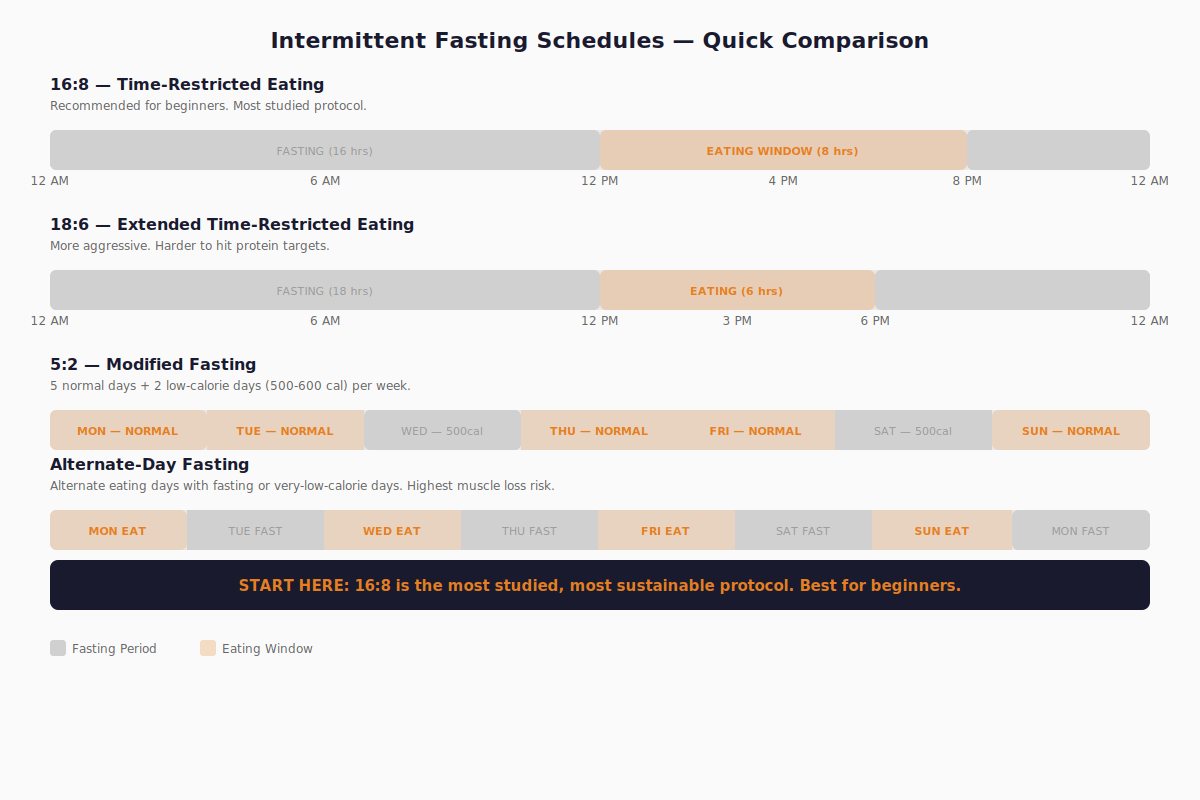
Four main protocols are backed by research. Here is how they compare.
16:8: Time-Restricted Eating Fast for 16 hours, eat within an 8-hour window. This is the most studied protocol. It is also the easiest to maintain. Skip breakfast. Eat from noon to 8 PM. That is it.
18:6: Extended Time-Restricted Eating Fast for 18 hours, eat within a 6-hour window. More aggressive. Evidence on whether the extra 2 hours of fasting produces measurably better results is thin. It does make hitting your protein target harder because you have fewer meals to work with.
5:2: Modified Fasting Eat normally for five days. On two non-consecutive days, limit calories to about 500-600. This works. It is also harder socially. Explaining to someone why you are eating 500 calories on a Tuesday is more work than skipping breakfast every day.
Alternate-Day Fasting Alternate between full eating days and fasting or very-low-calorie days. Research shows it works for fat loss. It also carries the highest risk of muscle loss and is the hardest to sustain.
For intermittent fasting results men can actually maintain: start with 16:8. That is the schedule this guide recommends.
How to Start Intermittent Fasting: A 7-Day Transition Plan

Do not jump into a 16-hour fast on day one. Your body is not used to going that long without food. Ramp up gradually.
Days 1-2: 12-Hour Window Eat from 8 AM to 8 PM. This is barely different from how most people eat. You are drawing a line and not crossing it after dinner. No late-night snacks after 8 PM.
Days 3-4: 14-Hour Window Eat from 10 AM to 8 PM. Push breakfast back by two hours. Drink water or black coffee in the morning. If you feel hunger, it passes. Hunger comes in waves, not a steady climb. Wait 20 minutes.
Days 5-7: 16-Hour Window Eat from noon to 8 PM. You are now on the full 16:8 intermittent fasting for men schedule. By day 7, your body should be adapted. Morning hunger should feel less urgent.
During the fasting window, these will not break your fast: water, black coffee, unsweetened tea. No sugar. No cream. No milk. No gum. No BCAAs. Any significant caloric intake, even 20 or 30 calories from cream in your coffee, breaks the fasted state.
What to Eat (and Avoid) During Your Eating Window

The eating window is not a free pass. If you break a 16-hour fast with a 2,000-calorie pizza, you will gain weight. The window is not magic. The calories still count.
Eat protein first. Every meal in your window should be built around it: chicken, beef, eggs, fish, Greek yogurt, cottage cheese. Target 1.6 to 2.2 grams of protein per kilogram of bodyweight.
Fill the rest of the plate with vegetables and whole foods. A simple framework: protein plus vegetables plus a carb source like rice or potatoes if your activity level demands it. This is not complicated. Eat like an adult.
For a full nutrition framework during your eating window, read the guide on how to eat for muscle and weight loss.
Avoid using IF as justification for junk food. The structure of the eating window is designed to reduce total intake. If you binge during the window, you are defeating the mechanism.
Who Should NOT Try Intermittent Fasting
IF is not for everyone.
Men with a history of disordered eating should avoid any fasting protocol. The restriction can trigger old patterns. If you have been underweight or struggle with food relationships, skip this.
Men with certain medical conditions, including diabetes requiring medication, should talk to a doctor before fasting. Going 16 hours without food on blood-sugar-lowering medication can be dangerous.
Men who are already lean and trying to build muscle may not benefit. If your goal is pure hypertrophy and you are at a healthy body fat percentage, the caloric surplus you need is harder to achieve in a compressed eating window.
Men whose schedules do not allow it. If you work night shifts or have unpredictable meal timing, forcing IF into your life creates more stress than it removes.
If you are in one of these categories, IF is not for you. There are other ways to control your intake. A calorie deficit for men works on the same principle without the time restriction.
FAQ
Does intermittent fasting for men cause muscle loss?
Short-term studies of 12 weeks or fewer show that 16:8 intermittent fasting with adequate protein and resistance training does not cause more muscle loss than traditional dieting. Alternate-day fasting may carry a higher risk.
What is the best intermittent fasting schedule for men?
For beginners, 16:8 is the most sustainable and best-studied protocol. Fast for 16 hours, eat within an 8-hour window. More experienced fasters may try 18:6 or 5:2. The best schedule is the one you can stick with.
Can you drink coffee while intermittent fasting?
Yes. Black coffee without sugar, cream, or milk does not break a fast. Water and unsweetened tea are also acceptable during fasting periods.
How much weight can you lose with intermittent fasting?
Research shows typical weight loss of 7 to 11 pounds over 10 weeks, equivalent to traditional calorie restriction. Individual results vary based on diet quality and total calorie intake during eating windows.
Does intermittent fasting affect testosterone in men?
Evidence is mixed. Some studies show an acute testosterone rise during fasting periods. Others suggest a potential decrease over weeks of consistent IF in lean, active men. Overweight men who lose weight through IF may see testosterone increase from fat loss alone.
What to Do Tomorrow Morning
Push your breakfast back by two hours. That is it.
If you normally eat at 7 AM, wait until 9 AM. Drink water. Drink black coffee. Go about your morning. When you eat, eat protein and vegetables like you normally would.
This is not a commitment to intermittent fasting. It is a test. One morning. Two hours later. See how it feels.
If it feels fine, push it back another hour the next day. If it feels miserable, eat breakfast at your normal time and try a different approach. The goal is not to force a system that does not fit. The goal is to find out whether this system works for you.
Do it tomorrow. Not Monday. Not when you have researched more. Tomorrow morning. Two hours later.
SEO Metadata:
– Focus Keyword: intermittent fasting for men – SEO Title: Intermittent Fasting for Men: Results, Muscle Loss & Truth – Meta Description: Intermittent fasting for men actually works for weight loss. Evidence on results, muscle preservation, testosterone, and how to start a 16:8 schedule. – URL Slug: intermittent-fasting-for-men – Primary Category: Physical Discipline (12) – Tags: intermittent fasting for men, 16:8 intermittent fasting, weight loss for men, intermittent fasting muscle loss, intermittent fasting schedule, intermittent fasting results, intermittent fasting testosterone
Internal Link Ideas:
– how-to-lose-weight-for-men: comprehensive weight loss guide – calorie-deficit-for-men: alternative approach to caloric control – eat-like-you-train-meat-vegetables-framework: nutrition framework during eating windows