You’ve been told to “get 8 hours” so many times you’ve stopped listening. The problem isn’t how long you’re in bed. It’s what your body is actually doing while you’re there. This protocol covers the six things that determine whether you wake up rebuilt or just unconscious for a few hours.
1. Sleep Quality vs. Sleep Quantity
Most men treat sleep like a punch card at a coffee shop. Get your eight stamps and you’re good. That’s not how any of this works.
FIELD NOTE
Your body cycles through sleep stages in roughly 90-minute blocks. You need to hit deep sleep (physical repair, testosterone production) and REM sleep (cognitive recovery, emotional regulation) multiple times per night. If you’re in bed for eight hours but waking up every 45 minutes. Snoring, overheating, checking your phone. You’re getting surface sleep, not recovery sleep.
Six hours of uninterrupted sleep with full cycle completion beats eight hours of fragmented garbage every time. The goal isn’t more time horizontal. It’s more cycles completed without interruption.
Think about it this way: one guy does three sets of squats with perfect form and progressive overload. Another guy wanders around the gym for two hours doing random machines with no plan. Same difference. [The Beginner’s Guide to Strength](/beginners-guide-getting-physically-stronger/) covers this training principle in detail. The same logic applies to sleep.
The key metric is sleep efficiency: time asleep divided by time in bed. Above 85% is solid. Below 80% means you’re spending too much time in bed not actually sleeping. If that’s you, lying there longer isn’t the fix.
2. The Wind-Down Protocol
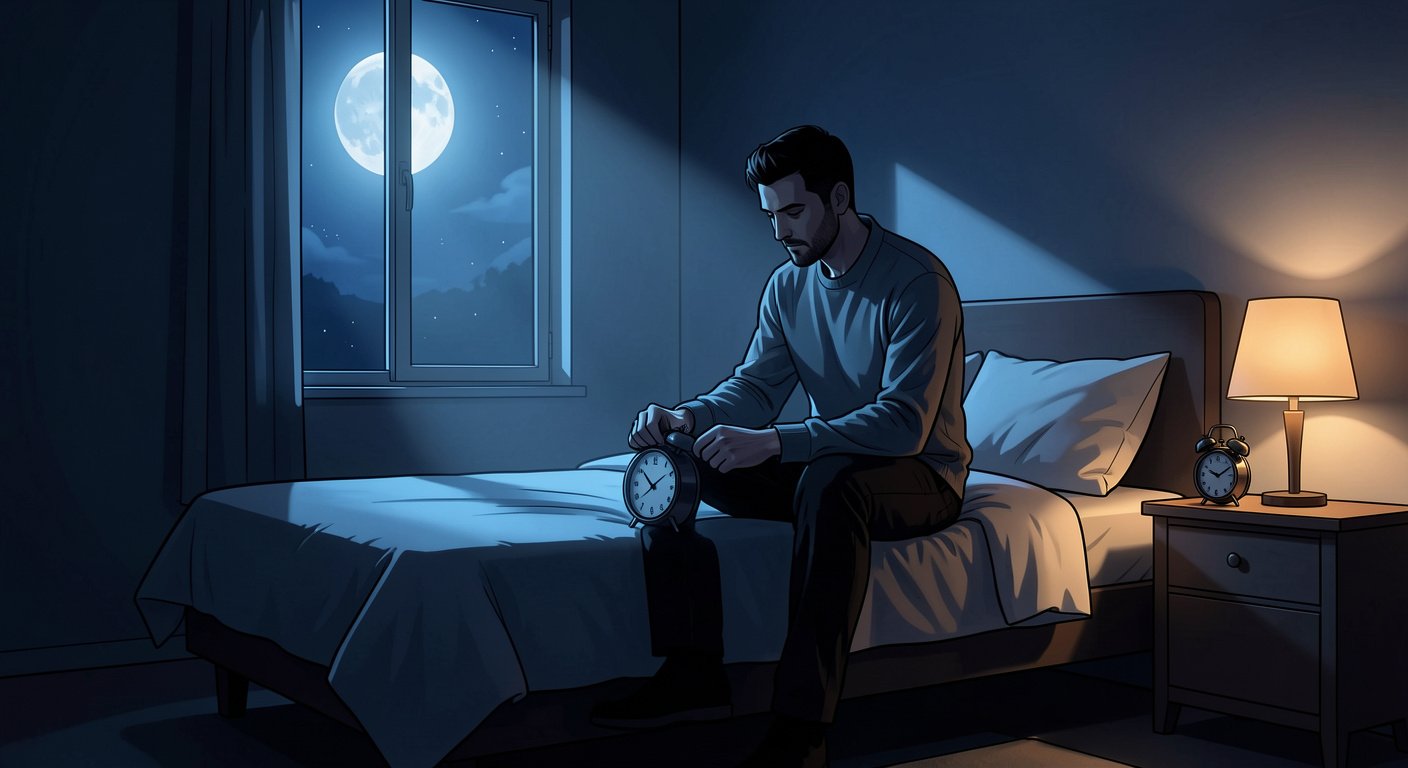
Your brain doesn’t have an off switch. It has a dimmer. If you’re staring at a screen until 11:47 and then expecting to be asleep at 11:49, you’re fighting biology and losing.
The protocol is simple. Sixty minutes before your target sleep time, you do three things:
First, kill the screens. Not “switch to dark mode.” Not “wear blue-light glasses while scrolling.” Off. Blue light from screens suppresses melatonin production for up to 90 minutes after exposure. Your phone’s night mode reduces blue light by maybe 30%. It’s not enough.
Second, do something low-stimulation. Read a physical book. Write in a journal. Stretch on the floor. Have a conversation with your partner that doesn’t involve logistics. The goal is to signal to your nervous system that the survival-input phase of the day is over.
Third, keep it consistent. Your circadian rhythm runs on pattern recognition. If you start your wind-down at 10pm Monday through Thursday and 1am Friday and Saturday, your body never learns when to trigger the sleep cascade. Pick a time. Stick to it six nights a week minimum. One flex night won’t kill you. Three will.
The wind-down isn’t about doing more. It’s about doing less. Removing stimulation. Letting the dimmer do its job. This is the [Minimum Effective Dose](/minimum-effective-dose-build-better-habits/) applied to sleep. The smallest intervention that produces the result you actually want.
3. Caffeine Timing
Here’s a fact most coffee-drinking men don’t want to hear: caffeine has a half-life of five to six hours. That means if you have a 2pm coffee, half of that caffeine is still circulating in your system at 7 or 8pm. At midnight. Ten hours later. A quarter of it is still there.
You don’t feel it, so you think it’s gone. It’s not. That quarter-dose is sitting on your adenosine receptors, blocking the chemical signal that tells your brain it’s time to sleep. You fall asleep anyway because you’re tired, but you never enter deep sleep properly. You wake up feeling like you need coffee. So you drink coffee. The cycle feeds itself.
The hard cutoff is 2pm. Not “I’ll just have a small one.” Not “espresso doesn’t count.” If you’re serious about sleep quality, caffeine after 2pm is borrowing energy from tomorrow and paying interest on it.
If you’re especially sensitive, and many men are without realizing it. Push that cutoff to noon. You’ll know within a week whether it matters. The first two days will suck. By day five, you’ll wake up differently. Clearer. Less groggy. Less dependent on the first cup to feel human.
And yes, this includes pre-workout. That 5pm scoop of pre-workout with 300mg of caffeine? At midnight, 75mg is still in your system. That’s basically a cup of green tea’s worth of caffeine actively working against your sleep while you’re trying to do it.
4. Your Sleep Environment Audit
Your bedroom is probably working against you in ways you haven’t noticed. Run this audit tonight.
Temperature. Your body needs to drop its core temperature by about 1-2°F to initiate sleep. If your room is too warm, that can’t happen. Set it between 65-68°F (18-20°C). If you wake up sweaty or kick off covers at 3am, your room is too hot.
Light. Total darkness isn’t a preference. It’s a requirement. Even small light sources (router LEDs, charger indicators, street light through curtain gaps) register through closed eyelids and suppress melatonin. Blackout curtains. Electrical tape over LEDs. Eye mask if you can’t control the environment. This sounds obsessive. Try it for three nights and tell me it doesn’t make a difference.
Noise. Consistency matters more than volume. A steady fan or white noise machine can mask irregular sounds (traffic, neighbors, dogs) that trigger micro-arousals. Brief wake-ups you don’t remember but that fragment your sleep cycles. If you live in a city, this one change can add 30-45 minutes of actual sleep to your night.
The phone. It doesn’t belong in your bedroom. Not on the nightstand. Not face-down. Not on airplane mode. Out. Buy a $10 alarm clock. If you use the “I need it for emergencies” excuse, put it in another room with the ringer on. You’ll hear it. The phone in your bedroom costs you sleep in three ways: the light, the temptation, and the psychological presence of every problem you’ve ever had sitting six inches from your head.
This audit isn’t complicated. It’s just uncomfortable because it means changing things you’re used to. Do it anyway. Your [testosterone levels](/10-ways-killing-testosterone/) depend on it. One night of poor sleep can drop circulating testosterone by 10-15%.
5. Training and Sleep
You train hard because you want results. But if you’re finishing a heavy session at 8pm and trying to sleep by 10, you’re stealing from the recovery that training is supposed to trigger.
Intense exercise elevates cortisol and core body temperature. Both of which need to drop for sleep to happen. A hard workout within three hours of bedtime keeps your nervous system in sympathetic mode (fight or flight) when it needs to be shifting to parasympathetic (rest and digest).
That doesn’t mean you can’t train in the evening. It means you need to adjust. If you lift after 6pm, prioritize lower-intensity work. Steady-state cardio, mobility, accessory lifts. Save the max-effort deadlifts and HIIT sessions for morning or early afternoon.
Morning training has a compounding advantage. It anchors your circadian rhythm, front-loads cortisol to its natural morning peak, and creates a fatigue curve that descends into the evening. If you can train before noon, do it. The sleep quality difference is measurable.
If evening training is your only option, extend your wind-down. Finish your workout by 7:30pm, take a cool shower to bring your core temperature down, and give yourself a full 90-minute buffer before bed. You’ll still get some cortisol elevation, but the cooldown period matters more than most guys realize.
6. Tracking Without Obsessing
MISSION BRIEF
Sleep trackers are useful tools and dangerous toys. The difference is how you use them.
Track these three things:
Wake time consistency. What time did you get out of bed? Is it within the same 30-minute window as yesterday? This is the single most predictive factor for sleep quality. More than total hours, more than bedtime.
How you feel ten minutes after waking. Don’t overthink this. Foggy or clear? Body heavy or light? Ready to move or dreading it? Your subjective experience is real data. Write down one word in a notebook. Over weeks, patterns emerge.
One behavioral variable at a time. This week, track caffeine cutoff adherence. Next week, wind-down consistency. Don’t track everything at once. You’ll drown in data and learn nothing.
Do not stare at your sleep score every morning like it’s a stock ticker. Do not lie in bed stressing about your “readiness score” being low. Do not wake up at 3am, check your tracker, and spiral about whether you’ve gotten enough deep sleep. This is called orthosomnia. The anxiety disorder created by sleep optimization. The tracker that’s supposed to improve your sleep makes it worse because you’re now performing for a device instead of listening to your body.
Your body knows when it’s rested. You knew before you had a tracker. Trust that signal more than the app.
The Bottom Line
ACTION PLAN
Pick one thing from this protocol and start tonight. Not all six. One.
If you’re drinking caffeine after 2pm, that’s your first move. If your phone is next to your bed, that’s your first move. If your room is too warm, fix it tonight.
Don’t optimize everything at once. That’s how you burn out on self-improvement. One change, done consistently for two weeks, will improve your sleep more than trying to implement this entire article by Monday.
Better sleep means better testosterone. Better recovery. Better decisions. Better patience with your kids and your partner. It’s the foundation everything else sits on. Fix this, and the rest of the work gets easier.

Comments are closed.