You have tried the meal plans. The ones with fourteen matching Tupperware containers and a spreadsheet your life never respects. By Thursday you are eating gas station jerky over the sink. It is not a discipline problem. It is a design problem. Plans break the moment life goes off script, and life always goes off script.
What you need is not another plan. You need a framework. Something that works at home, on the road, at a restaurant, or staring into an empty fridge at 9 p.m. This article gives you exactly that. Four simple rules built around protein, vegetables, and earning your carbs. No apps. No macros. Just a system you can follow for the rest of your life.
Meal plans fail because life doesn’t follow a spreadsheet. The meat-and-vegetables framework replaces rigid planning with simple rules: anchor every meal with protein, fill the rest of your plate with vegetables, and adjust carbs based on whether you trained that day. That’s it. Here’s the full system.
Why Meal Plans Fail 90% of Men
You’ve bought the chicken, the rice, the broccoli. You’ve stacked fourteen identical Tupperware containers in your fridge. By Thursday, you’re eating gas-station jerky over the sink because life happened.
This isn’t a discipline problem. It’s a design problem.
Meal plans assume your schedule is predictable and your willpower is infinite. Neither is true. A plan that requires chicken and sweet potato at exactly 12:30 p.m. Breaks the first time something goes off-script, and something always goes off-script.
The men who stay lean year-round aren’t the ones with detailed spreadsheets. They’re the ones with the simplest rules. Rules survive chaos. Plans don’t. The goal is a system that works on your worst Tuesday, not just your best Monday.
The Protein Anchor
Every meal starts with one question: where’s the protein?
Protein is the anchor. It’s non-negotiable. You don’t need to weigh your food or calculate macros, but you need a legitimate protein source at the center of every meal. Chicken, beef, pork, fish, eggs. Pick one. A portion the size and thickness of your palm. Done.
Protein can support fullness and helps supply amino acids used to maintain and repair muscle, but it is not calorie-free and it is possible to overeat any food. Use it as one part of a balanced meal rather than a loophole. If fat loss is the goal, learn how to set and monitor a calorie deficit for men without turning every meal into a math test. If you want a measured target, use this guide to calculate protein for weight loss without chasing an extreme number.
Breakfast, lunch, dinner. Every meal gets anchored. No protein, no meal. That’s rule number one.
The Plate Construction Method

No measuring cups. No food scales. Visual proportions only. Something your brain executes in three seconds anywhere.
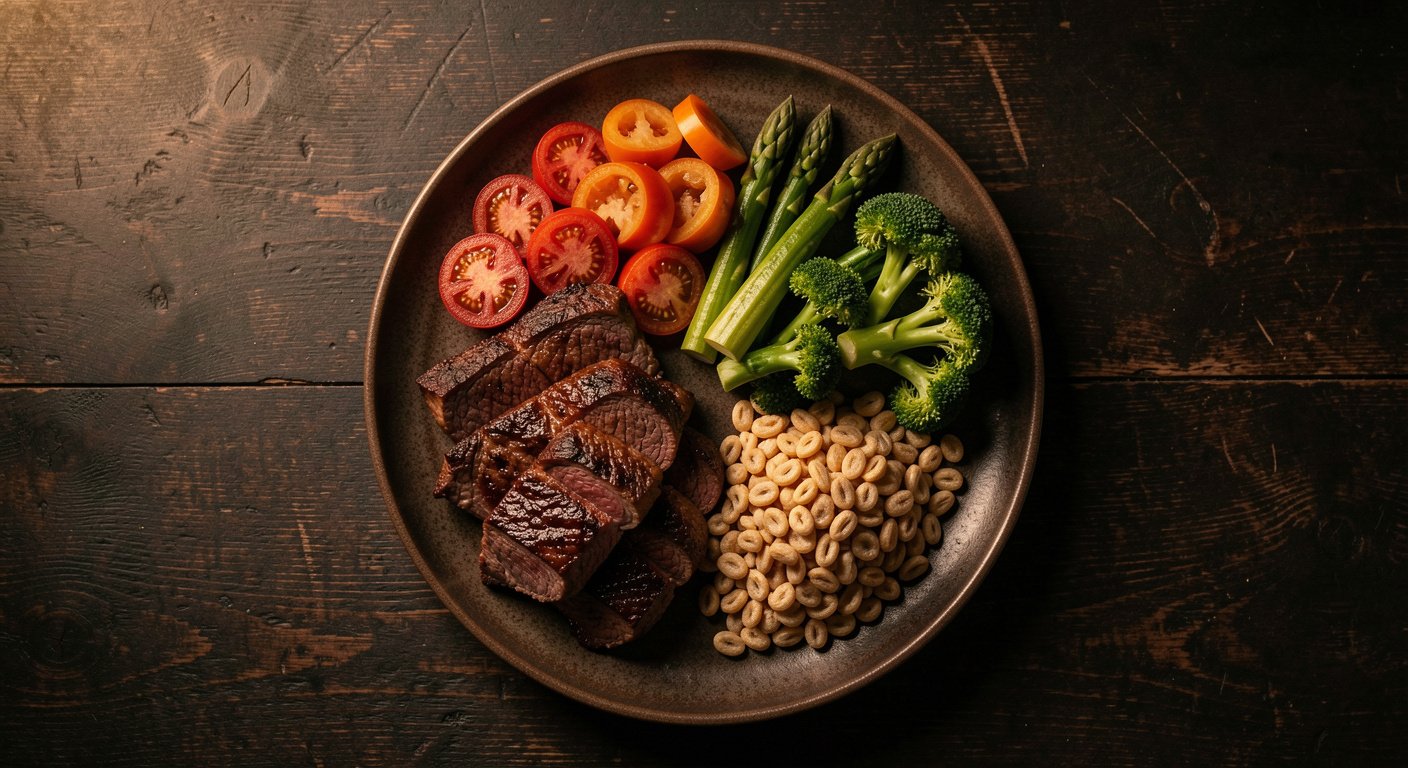
Divide your plate into three zones:
Zone 1: Protein (roughly 40%). Your palm-sized portion of meat, fish, or eggs. The centerpiece.
Zone 2: Vegetables (roughly 40%). Green, fibrous, abundant. Two fists’ worth. If your plate looks like a garden next to a steak, you’re doing it right.
Zone 3: Carbs (roughly 20%). On training days, occupied. On rest days, optional. Often empty.
That’s the method. It works at a diner, a wedding, an airport food court, or your mother-in-law’s table.
Vegetables Aren’t Optional
The rule: two fists’ worth of vegetables at lunch and dinner, minimum. Green things. Broccoli, spinach, asparagus, green beans, Brussels sprouts, zucchini, kale, cabbage. Roasted, steamed, sautéed, raw. Doesn’t matter as long as they’re not breaded, fried, or drowning in cream sauce.
If you currently eat almost no vegetables, don’t go from zero to two fists overnight. Start with one. Add spinach to your eggs. Microwave a bag of frozen broccoli and put it next to your steak. A man who consistently eats broccoli beats a man who buys kale and lets it rot.
Carbs: Train Hard or Skip the Pasta
Carbohydrates aren’t the enemy. But they’re not a free pass. The rule: carbs are earned through output, not justified through appetite.
On days you train. Real sessions, heavy barbell work, hard conditioning. Carbs belong on your plate. Your body needs them to replenish glycogen and fuel recovery. Eat your rice, potatoes, oatmeal. Put them in that 20% zone and move on.
On days you don’t train. Desk days, car days, couch days. Skip the starch. Your body isn’t depleted. Those carbs go to storage, not repair. Protein and vegetables only.
This isn’t keto or carb-phobia. This is matching fuel intake to fuel demand. What athletes have done for decades. Light session? Use judgment. Small carb portion, fine. Heaping plate of pasta after a day of meetings? No.
*Look at your plate before you eat. If you didn’t earn those carbs today, take them off.*
The 80/20 Enforcement Clause

Try to eat perfectly and you will fail. Perfection is the enemy of consistency, and consistency is the only thing that produces results.
The 80/20 rule is your release valve: 80% of your meals follow the framework. Protein-anchored, vegetable-loaded, carbs only when earned. The other 20%. About four meals a week. Eat whatever you want. Pizza with your kids. Wings with your friends. Date night. Dessert because it’s Wednesday.
This isn’t a cheat-day concept. Cheat days imply you did something wrong and need to atone. That’s a terrible relationship with food. The 80/20 rule accounts for the fact that you’re a human being with a social life.
When you’re in the 80%, don’t negotiate. When you’re in the 20%, enjoy it without guilt and without compensation. You don’t “make up for” a burger by skipping breakfast. You return to the framework at your next meal. No penance. Just a return to the rules.
You can endure any diet for six weeks. You can’t endure anything for six years. This clause is what makes the framework last decades.
Eating Out Without Blowing It

Restaurants are where most nutrition plans go to die. The menu is engineered to sell butter, cheese, and refined carbs. But the framework doesn’t abandon you at the table.
Step one: scan the menu for protein. Steak, chicken, fish, pork chop. Find your anchor. Ignore the pasta section unless you trained hard.
Step two: swap the starch for vegetables. Most restaurants will trade fries for broccoli, asparagus, or a side salad. Ask. If they won’t, order vegetables à la carte and leave the fries alone.
Step three: manage hidden calories. Sauces on the side. Dressings on the side. Skip the bread basket and sugary cocktails. You don’t need to order everything dry. Just be aware.
Step four: stop when you’re full. Restaurant portions are sized to justify the price, not to match your energy needs. You’re not obligated to clean the plate. Take the rest home.
Eating out is a test of whether you’ve internalized the rules. Pass it often enough and restaurants stop derailing your progress.
The Bottom Line
You’ve been overcomplicating this.
Eat protein at every meal. Cover the rest of your plate with vegetables. Carbs when you train, skip them when you don’t. Follow the rules 80% of the time and enjoy your life the other 20%. Apply the same framework at a restaurant you apply at home.
No macros. No meal timing windows. No supplements to research. Just meat, vegetables, and a few rules that work in the real world. You train with consistency, not complexity. Your nutrition deserves the same approach. Stop searching for the perfect plan and start building the plate in front of you. One meal at a time.
FAQ
*Do I need to count calories?*
No. High protein and vegetables keep you full on fewer calories by default. For lifelong maintenance, the visual plate method handles it. If you have a specific cutting goal, short-term tracking can help, but it’s not required.
*What about breakfast? I don’t eat meat in the morning.*
Eggs. Three or four, scrambled or fried, with a handful of spinach or leftover vegetables. Not hungry in the morning? Don’t eat. Intermittent fasting fits perfectly inside this framework. The rule is protein when you eat, not that you must eat at a specific time.
*What if I don’t cook?*
Rotisserie chicken from the grocery store. Canned tuna or salmon. Pre-cooked hard-boiled eggs. Frozen vegetables in the microwave. Bagged salad kits. You can assemble a framework-compliant meal in three minutes. Cooking is a bonus, not a requirement.
*Is this enough carbs for building muscle?*
If you’re training hard four to five days a week and eating carbs on those days, yes. If your weight isn’t moving, increase the carb portion from 20% to 25–30% on training days and watch the scale for two weeks. Adjust from there.
*What about fruit?*
Fruit is fine. It’s a carb source with fiber and micronutrients. Treat it like the carb zone. Appropriate on training days, optional on rest days. Nobody got fat eating apples.