
Discipline equals freedom — this is the core philosophy that separates men who command their lives from those who drift. Every area where you build discipline is an area where you gain real, undeniable freedom. This guide from The Better Man Project shows you how to build self-mastery from the ground up.
Most men hear “discipline” and think of a cage. Rules. Restrictions. A joyless life of grinding.
They have it completely backward.
Discipline is not your prison. It’s your key. Every area where you build discipline. Your body, your money, your time, your emotions. You gain real freedom. The man who can command himself answers to no one else. This essay shows you what discipline actually is, why you’ve been avoiding it, and how to build it starting today.The Real Problem
Something is wrong.
You live with more comfort and convenience than any generation in history. Food arrives at your door in 20 minutes. Every song ever recorded lives in your pocket. You can go days. Weeks. Without doing anything truly difficult.
And yet you don’t feel free.
You feel stuck. Tired. Anxious. Distracted. Like something important is slipping through your fingers and you can’t close your hand fast enough to catch it.
You’re not imagining things.
The problem isn’t your job, your relationship, your bank account, or your circumstances. The problem is your relationship with discomfort.
Somewhere along the way, you learned to avoid hard things. To negotiate with yourself. To wait until you “feel ready” or “feel motivated” or “feel like it.” Every time you chose the easy path, you traded a piece of your freedom for a moment of comfort.
Now the bill is coming due.
The man who cannot command himself will always be commanded by something else. Not by a person with a title. By subtler masters. Your phone. Picking it up 150 times a day without thinking. Your cravings. The snack, the drink, the scroll you reach for the moment you feel bored or anxious. Your moods. The days you lose because you “don’t feel like it.” Other people’s expectations. The life you live because you never decided to live your own.You didn’t choose this. Nobody wakes up and says, “I want to be a slave to my impulses.” But here you are.
And here’s the part that should scare you: most men never break out. They wake up at 45, look around, and wonder where their life went. They had talent. They had opportunities. They had moments where they almost turned it around. But they never built the engine that turns intention into action.
That engine is discipline. And the sooner you understand what discipline actually is. Not the fake guru version, not the shouting drill sergeant version. The sooner everything changes.
The Hard Truth
Let’s clear something up immediately.
Discipline is not punishment.Most men hear the word and picture boot camp. A man in a hat screaming. Pushups in the mud. Suffering for the sake of suffering. A gray, joyless existence where you never get to relax or enjoy anything.
That version is a lie. And it’s a convenient one. Because it gives you permission to reject discipline entirely. “I don’t want to be a robot.” “I value balance.” “Life is meant to be enjoyed.”
But real discipline. The kind that rebuilds men. Feels nothing like that.
It feels like control. Like waking up before your alarm because your body knows exactly what to do. Like looking at a distraction and genuinely not wanting it. Like moving through your day with clarity and purpose while everyone around you drifts.
Jocko Willink, the retired Navy SEAL commander, put the entire philosophy into four words:
“Discipline equals freedom.”He wasn’t writing a motivational poster. He was naming a law of human nature as consistent as gravity.
Here is the equation, broken down:
– Financial discipline = freedom from debt, money anxiety, and being trapped in a job you hate.
– Physical discipline = freedom from weakness, chronic fatigue, and a body that fails you early.
– Mental discipline = freedom from anxiety loops, overthinking, and the noise in your own head.
– Emotional discipline = freedom from being jerked around by your moods every single day.
– Time discipline = freedom from the panicked feeling that life is slipping away and you can’t stop it.
Every area where you lack discipline, you are not free. You are a hostage. And the hostage-taker isn’t some external enemy. It’s yesterday’s version of you, who made weak choices that handcuffed today’s version of you.
Weakness compounds. Small surrenders today become massive regrets tomorrow. The skipped workout. The impulse purchase. The hour lost to scrolling. Each one seems harmless in the moment. Each one steals a piece of the man you could have become.
The Stoics understood this two thousand years before Jocko Willink was born.
Epictetus, born a slave, crippled by a cruel master, taught the foundation of all self-mastery: “No man is free who is not master of himself.” He identified that there is exactly one thing in this world you control. Your own choices, your own mind, your own response. Everything else. Reputation, wealth, health, the behavior of others. Can be taken. But your choices? Those belong to you alone. If you don’t exercise that power, you are giving away the only thing that’s truly yours.
Marcus Aurelius, the emperor of Rome, the most powerful man in the world, wrote private notes to himself reminding the same thing: roll out of bed and do the work of a human being. Stop complaining. Stop hitting snooze. The warmth of the blankets is not your purpose.
If the emperor of Rome had to remind himself to get out of bed and do hard things, you are not special. You don’t get a pass.
Nobody is coming to save you.No app will fix your discipline problem. No morning routine video will work if you don’t have the foundational ability to do what you said you would do. No amount of motivation will carry you when the feeling fades, and it always fades, usually by Tuesday.
You either build the muscle of self-control, or you stay exactly where you are. Forever.
That is the hard truth. Sit with it.
What To Do Instead

Building real discipline is simpler than the internet wants you to believe. The self-improvement industry makes it complicated on purpose. Complicated problems sell expensive solutions. But the core principles fit on an index card.
Here are five that actually work.
1. Stop Negotiating With Yourself
The single biggest killer of discipline is the conversation you have inside your own head.
“I should go train.. But it’s been a long day.” “I should work on that project.. But I’m not feeling creative right now.” “I should get up.. But five more minutes won’t hurt.”Every time you have this negotiation, you lose something. Even if you eventually do the thing, you’ve burned mental energy you can’t recover. You’ve reinforced the habit of hesitating. You’ve practiced weakness.
The fix: remove the conversation entirely.When the alarm goes off, your feet hit the floor. There’s no debate. When it’s time to train, you train. When it’s time to work, you work. You don’t ask yourself how you feel. Feelings are not invited to the decision.
The SEALs have a phrase for this: default aggressive. No pause. No negotiation. No checking the internal weather report. The default action is always forward.
Start with one non-negotiable. One action you do every single day regardless of how you feel. It could be making your bed. It could be a 10-minute walk. It could be reading one page before you check your phone. The size doesn’t matter. The consistency does.
Pick one. Announce it. Then never negotiate it again.2. Do The Hard Thing First
Your willpower is strongest in the morning.
So put your hardest task first.
Brian Tracy popularized this as “eat the frog.” If you had to eat a live frog every day, you’d do it first thing in the morning. Because then nothing worse could happen to you for the rest of the day.
Most men do the exact opposite. They wake up, roll over, grab their phone, and scroll for 20 minutes. They’ve just spent their best mental energy on other people’s content, other people’s lives, other people’s drama. Then they wonder why they feel scattered and weak for the rest of the day.
If you don’t control your morning, your morning controls you.Wake up. Move your body. Do the hard thing. Then you can check your phone.
3. Build Disciplines, Not Just Goals
Goals are useful. They give you direction. But goals without systems are just wishes with a deadline.
A goal says: “I want to lose 20 pounds.” A discipline says: “I train at 6am Monday through Friday. No exceptions.”The goal is the destination. The discipline is the vehicle. And the vehicle matters more than the destination. Because once you have a working vehicle, you can go anywhere.
Write this down somewhere you’ll see it:
Your life is not defined by what you achieve. It’s defined by what you do daily.You want to be a writer? Write every day. You want to be strong? Train every day. You want to be calm? Practice stillness every day. You don’t need a finish line. You need a process you don’t stop.
The man with a one-year goal and no daily practice will fail. The man with no goal but an unbreakable daily practice will succeed. Every time.
4. Embrace Voluntary Discomfort
Here’s a strange truth that will change your life if you let it:
The more discomfort you choose, the less discomfort controls you.The Stoics called this voluntary hardship. Seneca, one of the wealthiest and most powerful men in the Roman Empire, would periodically sleep on the floor and eat only the plainest, cheapest food. Not because he had to. Because he wanted to train himself to fear nothing. Not poverty, not hunger, not hard ground.
Modern men are terrified of discomfort. You have been raised in a world engineered to be comfortable. Climate control. Memory foam. Endless entertainment. Food engineered in laboratories to be impossible to stop eating. You are softer than any generation in human history, and on some level, you know it. It’s part of why you feel restless and unfulfilled.
Start choosing difficulty on purpose.
– Take a cold shower. Start with 30 seconds at the end of a warm one.
– Fast for a day. Not for weight loss. To prove to yourself that hunger doesn’t own you.
– Train when you’re tired. Not at full intensity. Just show up and move.
– Have the hard conversation you’ve been avoiding for weeks.
– Wake up early when you don’t have to. On a Saturday, just because you said you would.
Each time you do something uncomfortable on purpose, you bank a deposit in your self-trust account. You prove to yourself: I can do hard things. I am not controlled by comfort. That confidence leaks into everything else.
5. Keep The Promises You Make To Yourself
At the bottom of everything. Beneath the habits, the routines, the cold showers, and the early alarms. There is a simple feedback loop.
You make a promise to yourself. You keep it. You trust yourself a little more.
Or: you make a promise to yourself. You break it. You trust yourself a little less.
That’s the whole game.
Every broken promise to yourself is a small vote that says: “I’m not reliable.” Every kept promise says: “I can count on me.”After enough broken promises, you stop believing change is possible. You develop a quiet, invisible form of learned helplessness. You call it “just who I am” or “I’m not a morning person” or “discipline just isn’t my thing.” But it’s not your identity. It’s your track record. And track records can be rewritten.
After enough kept promises. Even tiny ones. Something shifts. You start to trust yourself. Not in the fake-confidence, affirmations-in-the-mirror way. In the way a carpenter trusts his tools. Because they’ve been tested. They hold up under load.
Start small. Promise yourself you’ll walk for 10 minutes today. Then do it. Then do it again tomorrow. Then add one more promise.
The size of the promise matters less than the fact that you kept it.– Pick ONE non-negotiable daily action. Write it down on paper. Put it somewhere you see every morning.
– Remove one source of easy dopamine from your environment. Delete one app, move your phone charger across the room, cancel one streaming subscription.
– Do one thing you’ve been avoiding for more than a week. Doesn’t matter what. Just do it.
Tonight:– Set your alarm. Place your phone across the room so you have to stand up to turn it off.
– No screens for 30 minutes before bed. Read a book or just sit in quiet.
– Write down the hardest task for tomorrow. That task goes first. Before email, before phone, before anything.
Tomorrow morning:– Feet on the floor when the alarm sounds. No pause. No negotiation. No snooze.
– Move your body. Even if it’s just 10 pushups and a walk around the block.
– Complete your hard task before you open your phone or check any notifications.
Common Mistakes
Mistake 1: Trying to change everything at once.A man gets motivated on Sunday night. He decides he’s going to wake up at 5am, run 5 miles, eat clean, read for an hour, meditate, journal, and quit every bad habit simultaneously. Starting tomorrow. By Wednesday afternoon, he’s done. By Friday, he feels worse than when he started.
The fix: One discipline at a time. Master it for two weeks before you add the next. Patience is part of the discipline. Mistake 2: Using motivation as fuel.Motivation is a feeling. Feelings come and go. They’re affected by sleep, food, stress, weather, and a thousand other things you can’t control. If your discipline depends on feeling motivated, you will quit the first day you feel tired or sad or lazy. And that day is probably tomorrow.
The fix: Stop checking your emotional temperature before you act. Discipline is doing the thing regardless of how you feel. That’s the whole definition. Mistake 3: Failing to design your environment.You try to eat clean but keep junk food in the kitchen. You try to focus but leave your phone face-up on the desk, notifications blazing. You try to wake up early but your alarm is within arm’s reach of the snooze button.
The fix: Willpower is weak. Environment is strong. Make the right choice easy and the wrong choice inconvenient. Remove friction from your disciplines. Add friction to your distractions. Don’t trust yourself to resist temptation. Remove the temptation.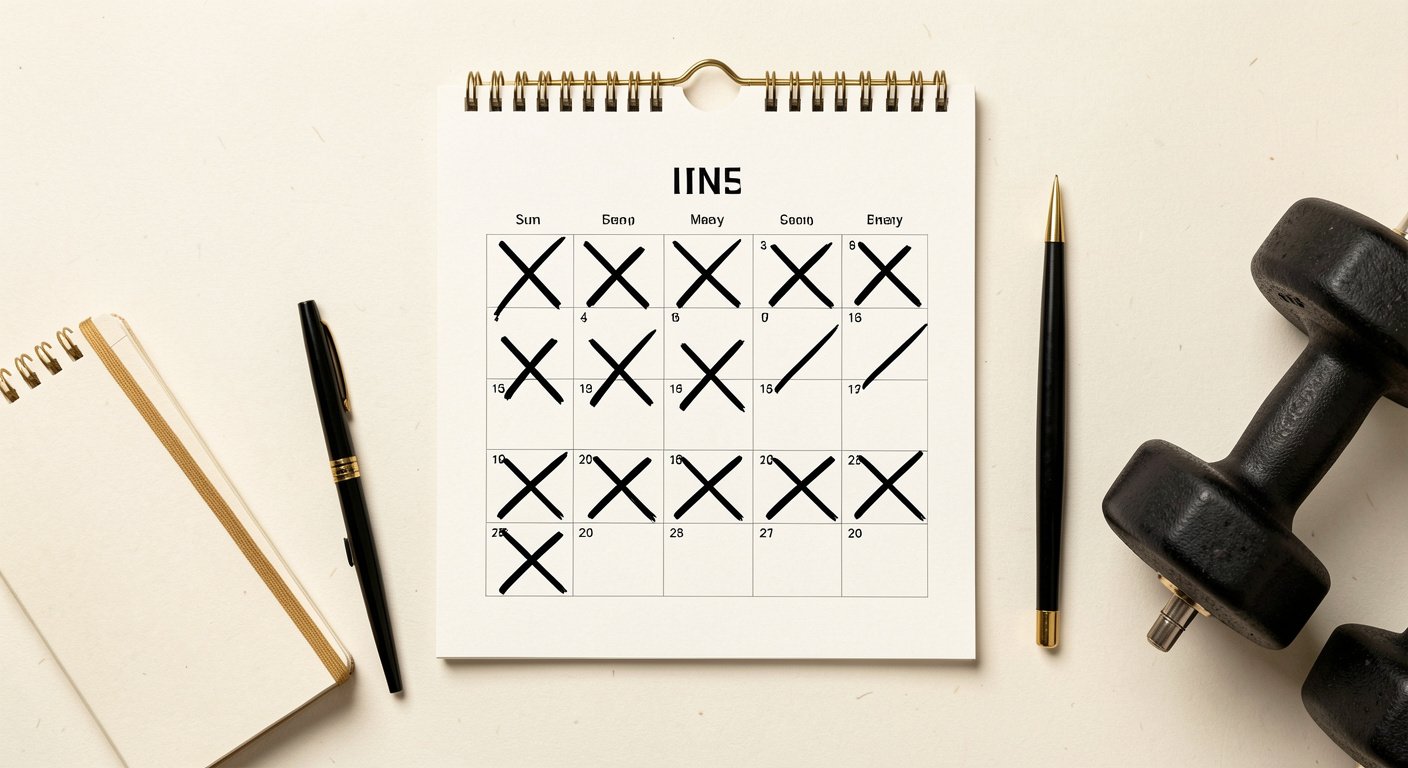
Here’s your single action. Right now. Today.
In the next hour, do one thing you don’t want to do.It doesn’t need to be big. Send the email you’ve been sitting on. Do 20 pushups. Have the hard conversation. Clean the mess you’ve been walking past all week. Apologize for something.
But here is the critical part: do it immediately. No pause. No negotiation. No checking how you feel.
Stand up right now and go do it.
Then notice what happens after. Notice the feeling in your chest. The quiet sense of control. The absence of the weight you’ve been carrying.
That feeling is freedom. Not the fake freedom of doing whatever you want. The real freedom of knowing that hard things don’t own you. You own them.Final Thought
Discipline is not a personality type. It’s not something you’re born with or born without. It’s not reserved for Navy SEALs and monks and men with unusual willpower.
Discipline is a skill. And like any skill, it can be built by any man willing to practice.The men you look up to. The ones who seem calm, capable, and unshakeable. They weren’t born that way. They built it. One decision. One uncomfortable morning. One kept promise at a time. They were exactly where you are now. The only difference is they started. And they didn’t stop.
You don’t need to fix your whole life today. The thought of that is paralyzing, and it’s why most men never start. You just need to win today. One disciplined day. Then you wake up tomorrow and do it again.
That’s the rhythm of self-mastery. That’s the path from where you are to who you want to be.
Discipline is not your prison. It is your way out.And it starts with whatever you choose to do next.
FAQ
Q: How long does it take to build real discipline?There is no magic number. But here is what’s true: you’ll notice a difference in yourself within two weeks. Other people will notice in two months. In two years, you won’t recognize the man you used to be. The timeline matters less than the consistency. One disciplined day is worth more than a year of planning and zero action.
Q: What do I do when I fail?You will fail. Every man does. The real question is not whether you fall. It’s how long you stay on the ground. Most men break a habit and immediately quit. “Well, I already messed up today. Might as well eat garbage and skip the gym and try again Monday.” That’s the real failure. Not the slip, but the surrender that follows it.
Get up faster. If you miss a morning, you haven’t lost the day. Win the next hour. Win the next decision. The faster you recover, the stronger your discipline becomes. The men who build lasting self-mastery are not the ones who never fall. They’re the ones who refuse to stay down. Q: Is discipline the same thing as willpower?No. Willpower is the short-term force you use to resist a single temptation in the moment. Discipline is the long-term system that makes willpower less necessary. A disciplined man doesn’t need to fight himself every day to go to the gym. It’s just what he does, because he’s built the structure around it. The goal is to make discipline automatic enough that willpower becomes your backup, not your main engine.
- Continue Building:
- Stop Waiting for Motivation: The Discipline Switch Every Man Needs to Flip
- How to Build Discipline When You Feel Lazy Every Day
- Finish What You Start: The Lost Art of Completion
- The 1% Rule: How to Compound Self-Discipline Into Success
- The Cheap Dopamine Trap: Why You Feel Like Sh*t and How to Fix It in 7 Days
- The Boredom Threshold: Why Finishing Boring Reps Builds Real Discipline
Comments are closed.