men’s accountability. By The Better Man Project
\n\n\n\nThe Real Problem: Most Men Were Never Taught What Accountability Actually Is
\nHere’s the honest truth: nobody sat you down and explained this.
\nWhat you absorbed instead was a patchwork of bad examples. A boss who used “accountability” to mean “I’m going to yell at you now.” A coach who made you run laps for mistakes but never taught you how to correct them. A culture that treats accountability as something that happens to you. A punishment, a consequence, an external force. Rather than something you choose.
\nNo wonder men avoid it.
\nBut here’s the shift that changes everything:
\n> Real accountability is not something done TO you. It’s something you step INTO. Voluntarily, deliberately, and with your eyes wide open.
\nThe men who understand this aren’t weaker for it. They’re the strongest men in any room. Because a man who owns his outcomes. All of them, the wins and the wreckage. Cannot be controlled by anyone who threatens to expose him. He’s already exposed. He’s already honest. He’s already free.
\nAccountability isn’t a cage. It’s a foundation. And most men are trying to build their lives without one.
\n\n
Why Men Avoid Accountability
\nLet’s name the reasons. Not to shame them. To see them clearly enough to move past them.
\n1. It Feels Like Surrender
\nFrom a young age, most men are taught that being wrong is weakness. Admitting fault is losing. The guy who says “I messed up” gets the lowered eyes, the disappointed head shake, the quiet judgment.
\nSo you learn to deflect. To explain. To justify. You build a reflex that fires before you even realize you’re doing it. Protecting your ego at the cost of your growth.
\nEvery time you deflect responsibility, you trade a chance to get stronger for a chance to look strong. And looking strong never made anyone actually strong.
\n2. No One Modeled It Well
\nYour father probably didn’t sit you down and say, “Son, here’s how you own a mistake and come out better on the other side.” Not because he was a bad man. Because nobody taught him either.
\nMost men inherited a model of accountability that looks like shame. Sit in the corner. Think about what you did. Feel bad until you’ve felt bad enough.
\nThat’s not accountability. That’s penance. And penance doesn’t build men. It just makes them feel small.
\n3. The Culture Confuses Accountability With Blame
\nModern conversation has blurred the line between being responsible for your actions and being blamed for everything. Accountability shouldn’t be a weapon. But many men have been on the receiving end of a version that felt more like attack than invitation.
\nSo you put your guard up. You get defensive. You protect yourself from a conversation that, done differently, could have made you better.
\nThe problem isn’t accountability. The problem is how you’ve seen it wielded.
\n\n\n
The Cost: What Avoiding Accountability Takes From You
\nThis is the part most men don’t calculate.
\nWhen you avoid accountability, you’re not dodging punishment. You’re paying a price, and the currency is everything that matters.
\nSelf-Respect
\nEvery time you deflect a mistake instead of owning it, you file a piece of evidence. Your subconscious is always watching. It records every justification, every blame-shift, every “it wasn’t really my fault.”
\nOver time, that evidence pile becomes a verdict: you cannot trust yourself.
\nAnd a man who doesn’t trust himself becomes desperate for external validation. He needs other people to tell him he’s okay because he’s stopped believing it himself.
\nSelf-respect isn’t built on wins. It’s built on owning the losses honestly.
\nCredibility With Others
\nPeople notice. Your partner notices when you can’t say “I was wrong” without attaching a “but.” Your kids notice when you make excuses instead of apologies. Your friends notice when you’re always the victim in every story you tell.
\nThe man who won’t own his mistakes loses the right to be taken seriously. Not because people are judging him. Because they’ve learned his words don’t match reality.
\nThe Man You Could Have Been
\nThis is the invisible cost. The one that doesn’t show up on any invoice.
\nEvery mistake you deflect is a lesson you refuse. Every failure you blame on circumstances is a growth opportunity you hand to someone else. Over a decade, the gap between the man who owns his outcomes and the man who blames his circumstances becomes unbridgeable.
\nAvoiding accountability doesn’t protect you from consequences. It protects you from growth. And growth is the only thing that separates the man you are from the man you could become.
\n
The Shift: Accountability as Power
\nHere’s where everything changes.
\nWhat if accountability wasn’t about what you owe other people? What if it was about what you give yourself?
\nOwnership = Agency
\nWhen you blame circumstances, you hand your power to the circumstances. When you blame other people, you hand your power to other people. When you blame luck, timing, the economy, your upbringing. You are, in that moment, declaring yourself powerless over your own life.
\nOwnership is the opposite of victimhood. And victimhood is the most expensive identity a man can carry.
The moment you say “I did this”. Even when it’s uncomfortable, even when it’s embarrassing, even when there were genuinely other factors involved. You reclaim something. You stop being someone things happen to and become someone things happen through.
\nThat’s not punishment. That’s power.
\nThe Promise-to-Yourself Connection
\nThis is where accountability and self-respect become the same thing.
\nEvery time you make a promise to yourself and keep it, you’re practicing accountability. Every time you set a standard and meet it. Even when no one would have known if you didn’t. You’re building the muscle.
\nThis is why we wrote about keeping your word as the foundation of self-respect. The promises you keep to yourself are the bricks. Accountability is the mortar that holds them together.
\nA man who keeps his word to himself doesn’t need anyone to validate him. He’s already validated. By his own track record.
\nThe Freedom on the Other Side
\nHere’s something nobody tells you: the most relaxed men you’ll ever meet are also the most accountable.
\nThey don’t carry the weight of hidden failures. They don’t have a mental spreadsheet of justifications they might need to deploy. They don’t flinch when someone asks a hard question because they’ve already asked themselves harder ones.
\nAccountability is heavy at first. But it gets lighter the longer you carry it. Because it replaces secrets, justifications, and lies with something much easier to hold: the truth.
\nRelated: [Stop Lying to Yourself. The First Rule of Becoming a Better Man]
\n\n\n
Building Your Accountability System: The Practical Playbook
\nKnowing accountability is power doesn’t make it automatic. You need a system. Here’s what actually works.
\n1. Start With the Man in the Mirror
\nBefore you involve anyone else, you need a practice of self-accountability that isn’t performative. This is just you and you.
\nThe Daily Debrief: Two minutes at the end of every day. Ask yourself three questions:
\n1. What did I say I’d do today that I actually did?
\n2. What did I say I’d do that I didn’t, and why, honestly?
\n3. What’s one thing I’ll own tomorrow?
\nNo judgment. No self-flagellation. Just data. Just honesty. You’re not a prosecutor building a case against yourself. You’re an engineer diagnosing a system.
\nThe Monthly Audit: Once a month, go deeper. Where did you make excuses? Where did you blame something external that was actually your responsibility? Where did you keep your word to yourself, and where did you break it?
\nWe built a full guide on this practice here: The Solo Check-In: A Monthly Audit Every Man Needs.
\n\n
2. Find Men Who Will Call You Out
\nThis is the part most men resist, and the part that changes everything.
\nSelf-accountability is necessary. It is not sufficient. You have blind spots. You have justifications you’ve been running so long they feel like facts. You need other men who see you clearly and care enough to tell you the truth.
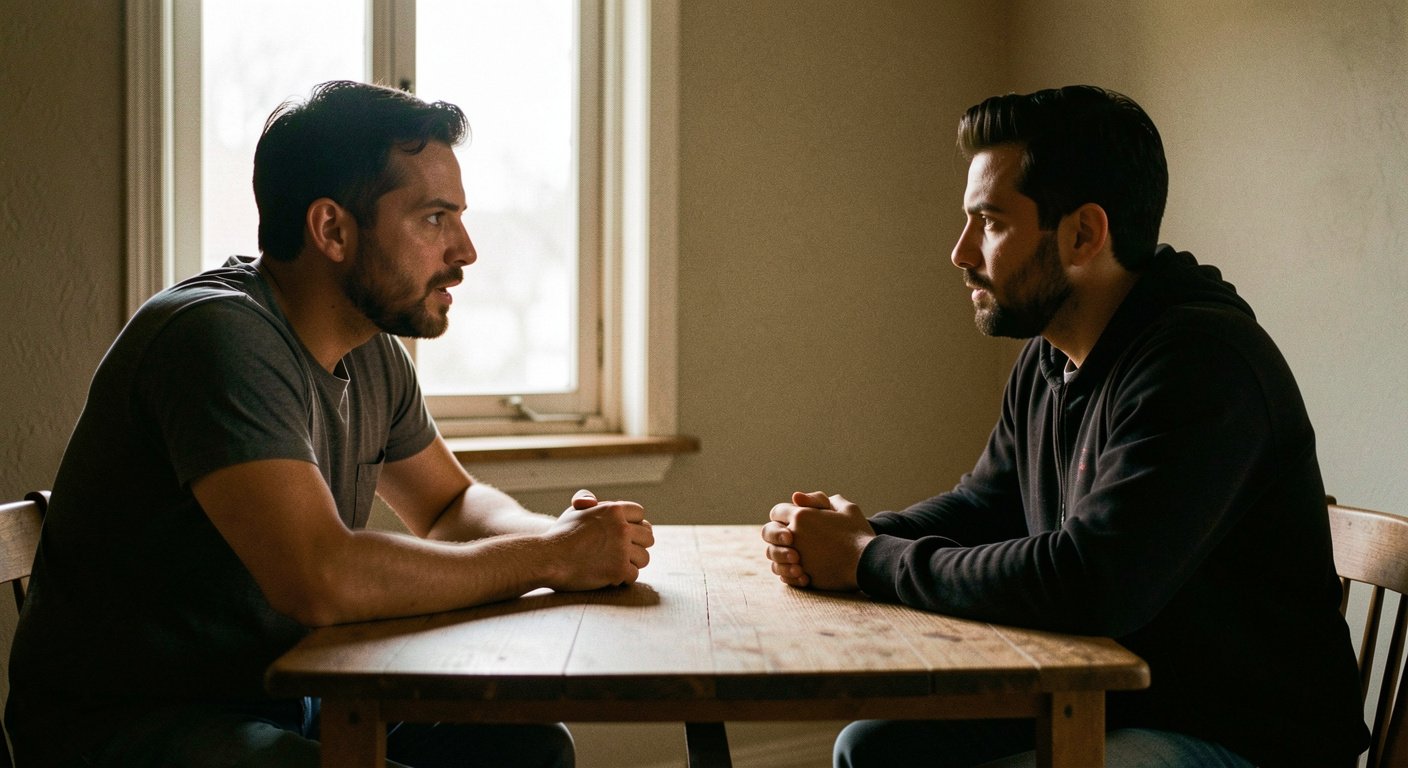
\nThis isn’t about finding someone to shame you. It’s about finding someone who respects you enough to say: “That’s not what you said you were going to do. What happened?”
\nAn accountability partner isn’t a parole officer. He’s a brother who wants you to win.
\nThe right men in your life make accountability easier, not harder. Because the standard is shared, not imposed. When you’re surrounded by men who own their outcomes, owning yours stops feeling like exposure and starts feeling like belonging.
\nWe wrote about this dynamic in depth: Why Your Friends Determine Your Future: The Social Circle Audit Every Man Needs.
\n3. Close the Loop on Everything You Start
\nAccountability isn’t just about admitting mistakes. It’s about finishing what you begin.
\nEvery unfinished project and broken commitment is a small leak in your self-trust. You might not feel it day to day, but over time the leakage adds up. You become the guy who starts things and doesn’t finish them, and you start believing that’s just who you are.
\nCompleting what you start is a form of accountability to your future self. The man you’ll be in six months is counting on the promises you make today.
\nFor a deeper dive on this discipline: Finish What You Start: The Lost Art of Completion.
\n4. Make Your Word Mean Something Again
\nAt the core of accountability is a simple, brutal standard: do what you said you’d do.
\nNot “try.” Not “intend.” Do.
\nWhen you tell someone you’ll be there at 7, be there at 6:55. When you say you’ll handle something, handle it. When you make a commitment, treat it as binding. Even if the only person who’d know you broke it is you.
\nYour word is either currency or noise. You decide which one. Every single day, with every single promise.
\nStart small. Under-promise and over-deliver. Let the evidence accumulate that when you say something, the universe can count on it. That includes you counting on yourself.
\n\nThe Hardest Part: Owning It When It Hurts
\nLet’s be honest about something.
\nOwning your mistakes is easy when the mistake is small. “Sorry I’m late”. Fine. “I forgot to grab milk”. No problem.
\nThe real test is when owning it costs you something. When admitting you were wrong might damage a relationship, cost you money, or force you to rebuild something you spent years constructing.
\nThose are the moments that separate men who perform accountability from men who live it.
\nHere’s what to remember in those moments:
\nThe short-term cost of ownership is almost always lower than the long-term cost of deflection. Yes, owning the big mistake hurts right now. But the alternative. The lie, the cover-up, the slow erosion of trust that happens over months and years. Costs far more.
\nPeople forgive mistakes. They don’t forgive dishonesty. A man who says “I blew it. Here’s what happened. Here’s what I’m doing about it.” earns something more valuable than the mistake cost him: respect.
\nFinal Message
\nBrother, here’s what I want you to sit with.
\nAccountability isn’t a weight someone puts on your shoulders. It’s a foundation you build under your own feet. The difference is everything.
\nA man without accountability is a house built on sand. He looks fine when the weather’s good. When things are easy. When nobody’s asking hard questions. But the first storm that hits. A crisis, a failure, a relationship under pressure, and the whole structure starts to shift. Because there’s nothing solid underneath.
\nA man with accountability is a house built on rock. Storms still come. He still gets hit. But he doesn’t collapse. Because he knows who he is, what he stands on, and that he can look at the wreckage honestly and start rebuilding.
\nAccountability is the difference between hoping you’re a good man and knowing you’re a man who can be counted on.
\nYou don’t have to get this perfect. You don’t have to own everything overnight. Start with one thing. One promise to yourself, one honest conversation, one moment where you choose ownership over deflection.
\nThen do it again tomorrow. And the day after.
\nThe man who owns his outcomes owns his life. Everything else is just waiting to see what happens to you.
\n\n🔨 The Better Man Challenge
\nThis week, do three things, but one at a time. Don’t try to be a hero. Just be honest.
\nLevel 1. The Mirror Check:
\nTonight, before you go to sleep, answer one question in writing: What is one thing I blamed on someone or something else this week that was actually my responsibility? Write it down. Don’t show anyone. Just own it to yourself.
\nLevel 2. Close a Loop:
\nIdentify one commitment you made. To yourself or to someone else. That you haven’t followed through on. Finish it this week. Even if it’s small. Even if it’s late. Close the loop. Prove to yourself that your word still means something.
\nLevel 3. The Conversation:
\nReach out to one man you trust and say this: “I’m working on being more accountable. To myself and to the people who count on me. Would you be willing to check in with me on it once in a while?” That’s it. No big speech. Just an invitation.
\nStart with Level 1 tonight. Not tomorrow. Not when you feel ready. Tonight. Before your head hits the pillow.
\nThen come back and tell us how it went. Drop a comment. The men in this community are walking the same path, and the conversation about accountability isn’t theoretical. It’s happening right now, in real lives, in real men who are choosing to be better.
\nYours included.
\n\nThe Better Man Project helps men build character, self-respect, and quiet strength. Without the posturing and without the apologies.
\n\n\n\n
- \n
- Keeping Your Word Is the Foundation of Self-Respect \n
- Stop Lying to Yourself. The First Rule of Becoming a Better Man \n
- Finish What You Start: The Lost Art of Completion \n
- The Solo Check-In: A Monthly Audit Every Man Needs \n
- Why Your Friends Determine Your Future: The Social Circle Audit Every Man Needs \n
Comments are closed.