Why Most Morning Routines Fail for Night Owls
You’ve seen the videos. Some shredded guy with a ring light telling you to wake up at 4:30 AM, take a cold plunge, journal for 45 minutes, and meditate before the sun comes up. The comments are full of guys saying “Day 1, let’s go.” By Day 6, they’re back to hitting snooze four times and feeling like failures.
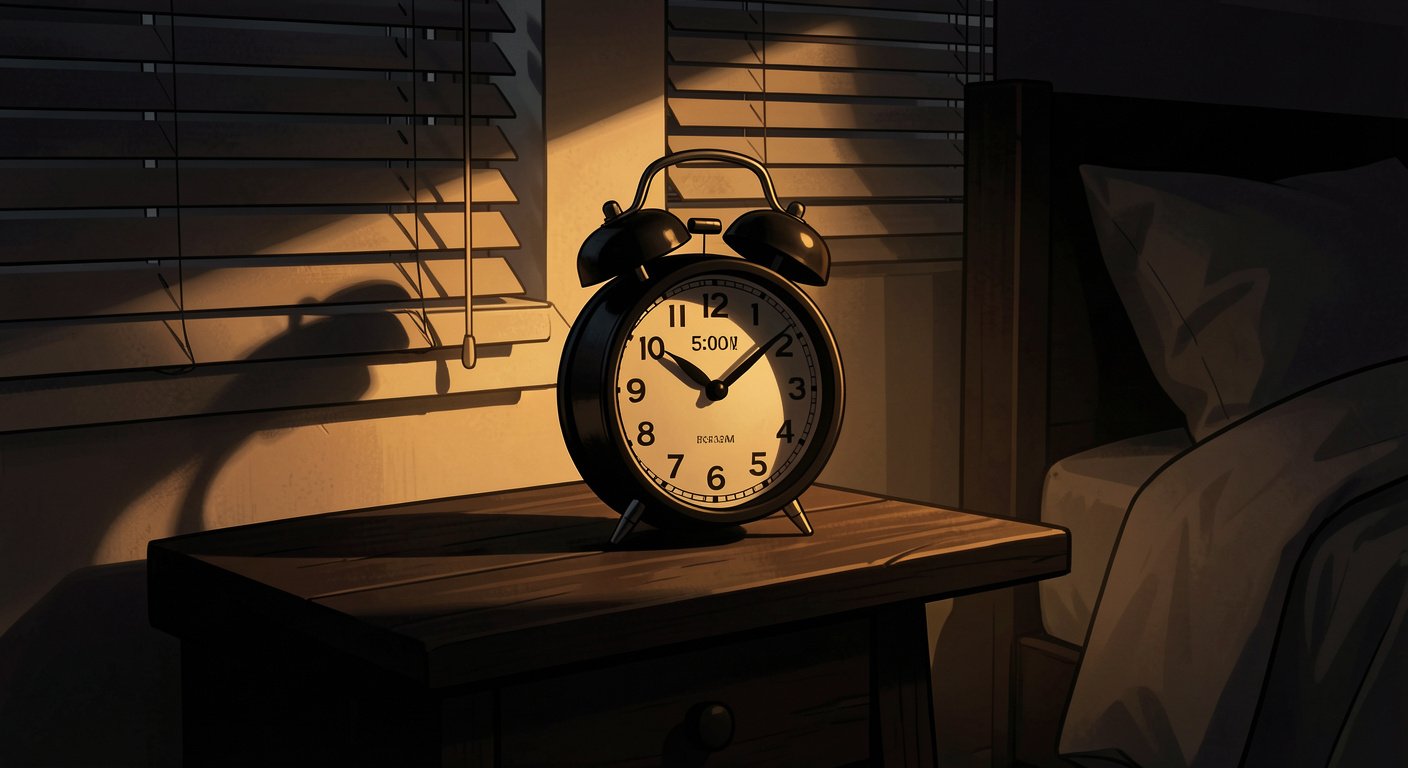
Here’s the truth nobody tells you: morning routines are not about waking up early. They’re about waking up with control. And for men who naturally hate mornings â the guys whose brains don’t fire until 10 AM â forcing a 5 AM wakeup isn’t discipline. It’s self-sabotage.
These five rules aren’t about becoming a morning person. They’re about building a routine that actually sticks, even if you’d rather throw your alarm clock against a wall.
Rule 1: The Wake-Up Window Replaces the Wake-Up Time
Forget setting an alarm for 6:00 AM sharp. Instead, give yourself a 30-minute wake-up window.
Here’s why this works: when you set a rigid time, every minute you oversleep becomes a failure. You wake up at 6:07 and your first thought is “I already screwed up.” That’s a terrible way to start your day. That negative self-talk cascades â you’re more likely to skip your workout, eat like garbage, and waste the whole morning because you already “failed.”
Set a window instead. Say your window is 6:30-7:00 AM. Any wakeup in that range counts as a win. This small psychological shift is massive. You’re no longer someone who “overslept” â you’re someone who woke up within your planned window.
The science backs this up. Sleep cycles run in roughly 90-minute intervals. Waking up mid-cycle produces sleep inertia â that groggy, hungover feeling that makes you want to murder whoever invented mornings. A 30-minute window increases your odds of waking near the top of a cycle instead of deep in REM sleep.
How to implement: Set your window based on when you actually need to be functional, not some idealized fantasy version of yourself. If your first commitment is at 9 AM, a 7:00-7:30 window gives you 90 minutes to move, eat, and get ready. That’s plenty.
Rule 2: The First Action Is Physical, Not Mental
Do not â under any circumstances â start your morning by looking at your phone.
When you check emails, Slack, or social media within the first 15 minutes of waking, you hand control of your mental state to other people. Some client is pissed. Your ex posted something. The news is depressing. Your brain is now in reactive mode before you’ve even brushed your teeth.
The first thing you do after opening your eyes needs to be physical. Not a full workout â just something that tells your nervous system “we’re awake now.” This bypasses the mental resistance that kills morning routines.
Options that take under 2 minutes:
- 10 pushups right next to your bed
- Stand up and stretch your arms overhead for 60 seconds
- Walk to the kitchen and drink a full glass of water
- Splash cold water on your face and hold it there for 10 seconds
The key is that this action requires zero decision-making. You don’t choose whether to do it â you just do it. The moment your feet hit the floor, you’re in motion. Motion creates momentum. Momentum beats motivation every single time.

Rule 3: The Night-Before Setup Kills Morning Friction
Morning you is an idiot. He’s groggy, unmotivated, and will take any excuse to crawl back into bed. Don’t trust that guy with decisions.
Night-before you is sharp, capable, and can set Morning you up for success in 10 minutes. Remove every possible friction point before you go to sleep:
- Lay out your clothes â including socks and underwear
- Set up your coffee or pre-workout so all you do is press a button
- Put your phone on the other side of the room (forcing you to get up to turn off the alarm)
- Write down your ONE priority for the next morning on a sticky note
- Pack your gym bag and put it by the door
This is the “reduce activation energy” principle from behavioral psychology. Every extra step between you and an action makes you less likely to do it. A study published in the European Journal of Social Psychology found that reducing friction was more effective for habit formation than increasing motivation.
Make the right choice the easy choice. Make the wrong choice require effort.
Rule 4: The Non-Negotiable Anchor Habit
Your morning routine only needs ONE thing that absolutely must happen. Not five things. Not a 90-minute optimization protocol. One anchor habit.
When guys fail at morning routines, it’s almost always because they tried to change everything at once. Wake up early. Work out. Meditate. Journal. Read. Cold shower. Make a smoothie. By Wednesday they’ve done none of it and feel like garbage.
Pick one anchor. It should be something that, when you do it, makes the rest of your day better. Examples:
- 10 minutes of stretching or mobility work
- Writing down three things you’ll accomplish today
- A 15-minute walk outside (no phone, no headphones)
- Eating a real breakfast with protein
Do this one thing for 30 days straight before you add anything else. When you skip it â and you will skip it some days â the rule is simple: never miss twice. One missed day is a blip. Two missed days is the start of a new pattern.
Once your anchor habit is locked in, you can stack other habits onto it. This is called habit stacking, and it works because you’re building on an existing neural pathway instead of creating a new one from scratch.
Rule 5: The Weekend Bridge
This is where most morning routines die. Monday through Friday, you’ve got structure. Saturday hits and the whole thing collapses. By Monday morning you’re starting from zero again.
The weekend bridge is simple: keep your wake-up window within 60-90 minutes of your weekday window. If you normally wake between 6:30-7:00, don’t sleep past 8:30 on weekends. You can still enjoy a lazy Saturday morning â you’re just not resetting your circadian rhythm every single weekend.
You don’t need to do your full routine on weekends. The anchor habit is negotiable. But the wake window isn’t. Sleep researchers call this “social jetlag” â when your weekend sleep schedule differs drastically from your weekday schedule, your body experiences something similar to flying across time zones. Every. Single. Week.
A 2017 study in the journal Sleep found that social jetlag was associated with poorer health outcomes, worse mood, and increased fatigue â independent of how many total hours people slept.
Keep the window. Let the rest flex. That’s the bridge.

Your 5-Rule Morning Routine Checklist
Print this. Tape it to your wall. Read it when morning you is trying to convince you that hitting snooze is a personality trait.
- The Wake-Up Window. Set a 30-minute window (e.g., 6:30-7:00 AM). Any wakeup in that range counts as a win. No more “I already failed” at 6:07 AM. Your window: ________ to ________
- Physical First Action. Before you touch your phone, do one physical thing. 10 pushups. A full glass of water. Splash cold water on your face. Decision-free motion. Your first action: ________
- Night-Before Setup. Lay out clothes. Set up coffee. Phone across the room. One priority on a sticky note. Takes 10 minutes. Saves 30 minutes of morning friction. I will set up tonight at: ________ PM
- Anchor Habit. Pick ONE thing that must happen. Morning walk. Stretching. Real breakfast. Do it for 30 days before adding anything else. My anchor habit: ________
- Weekend Bridge. Keep your wake window within 90 minutes of your weekday window. Never sleep past: ________ AM. The anchor habit is flexible. The window is not.
The only rule that matters: Never miss twice. One skipped day is a data point. Two skipped days is a new pattern. If you miss Tuesday, Wednesday is non-negotiable.
Start tonight. Fill in the blanks above. Take 10 minutes to set up your space. Then go to sleep knowing that morning you. The groggy, unmotivated version. Has already been set up for success by the version of you that still has a functioning prefrontal cortex.
The Real Point
Morning routines aren’t about optimizing your cortisol levels or hacking your mitochondria. They’re about starting the day on your terms instead of reacting to whatever the world throws at you.
For men who hate mornings, the goal isn’t to love them. It’s to own them. Use these five rules â the window, the physical first action, the night-before setup, the anchor habit, and the weekend bridge â and you’ll have a system that works whether you’re a natural early riser or someone whose brain doesn’t fully boot up until noon.
Stop trying to become a morning person. If you need a 7-day reset to get back on track, start becoming a person who controls his mornings.