Most men who want to get stronger start by asking the wrong question. They ask “what exercises should I do” before they understand what strength is, let alone how to get physically stronger.
Strength is not a look. It is not the size of your arms or the shape of your chest.
Strength is your body’s ability to produce force against resistance. That is it.
If you can move more weight, do more reps, or hold a position longer than you could last month, you are stronger. The mirror may not agree yet. The numbers will.
This guide explains how to start strength training and how to get physically stronger from the ground up.
If you want to know how to build strength as a beginner without joining a gym or following a complicated program, this is it. It is beginner strength training for men who want a system, not a list of exercises.
The guide ends with a template you can run tomorrow morning in your living room.
If you have not exercised at all in years and need help building the habit first, start with how to start working out from zero. That article covers the four-week on-ramp this one assumes you have already taken.
How to Get Physically Stronger: What Strength Means
Strength is a measurable physical quality. It is not confidence. It is not discipline. It is force production: the ability of your muscles to contract against an external load.
The American College of Sports Medicine published updated resistance training guidelines in March 2026. It was the first update in 17 years.
The review pulled from 137 systematic reviews covering over 30,000 participants. Their core finding: any form of resistance training produces marked benefits, and consistency and effort matter more than program complexity (ACSM, 2026).
What does this mean for you?
You do not need a complicated program. You do not need a gym. You need to apply resistance to your muscles, recover, and then apply slightly more resistance next time.
Strength is not about how much you lift once. It is about whether the numbers go up over weeks and months.
Your Nervous System Gets Stronger Before Your Muscles Do
Here is the thing most beginners never hear: in the first four to eight weeks of strength training, your muscles are not the main thing changing. Your nervous system is.
Your brain learns to recruit more muscle fibers at once. It learns to coordinate them more efficiently. It learns to fire them faster.
This is called neural adaptation, and it is the reason beginners can get measurably stronger before they look any different.
Research on neuromuscular adaptation shows that early strength gains are driven primarily by improved motor unit recruitment and coordination, not by increases in muscle size. Strength can increase before visible hypertrophy occurs (PubMed, Hakkinen et al.).
This matters because most men quit during this window. They train for three weeks, see the same body in the mirror, and decide it is not working.
But the numbers were going up. They were getting stronger. They did not know what to look for.
Track your reps. Track your load. Trust the numbers. The mirror catches up later.
The 5 Movement Patterns Every Strength Program Needs
Your body does not know exercises. It knows movement patterns. An effective strength program is built on five of them, and these movement patterns are the strength training fundamentals every beginner should learn.
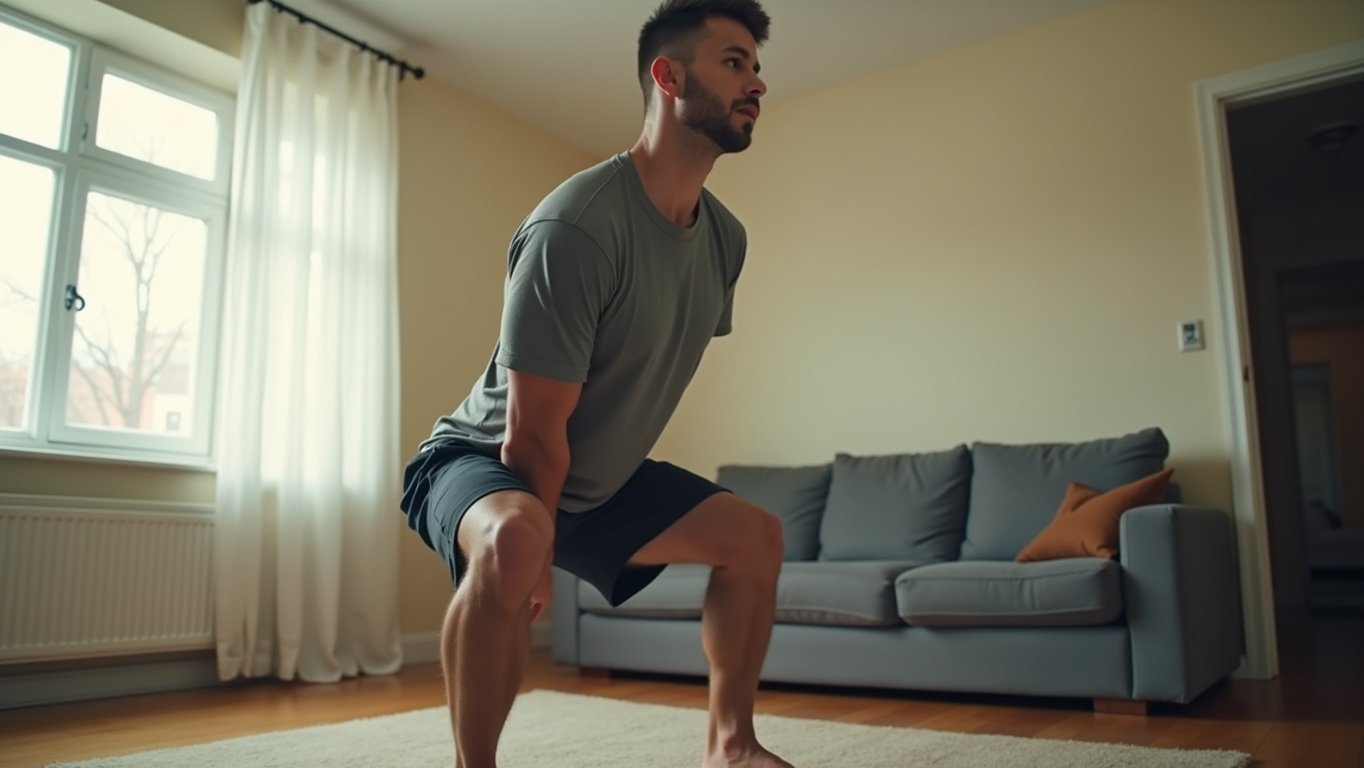
Squat. You bend your knees and hips, lower your body, and stand back up. Squatting trains your legs, hips, and core. Bodyweight version: air squat. Loaded version: goblet squat with a dumbbell or backpack held at your chest.
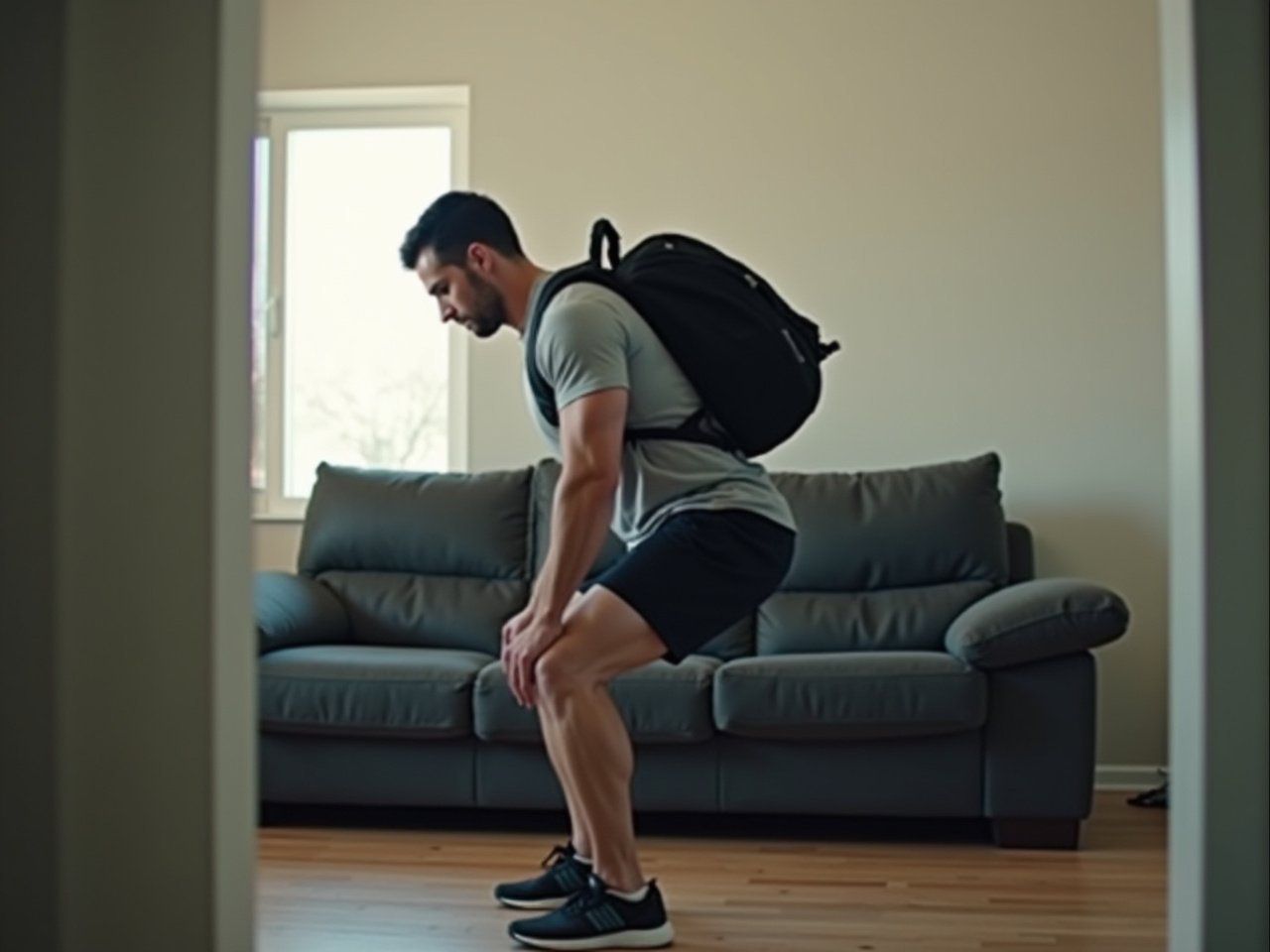
Hinge. You bend at the hips while keeping your back straight, then drive your hips forward to stand. This trains your posterior chain: hamstrings, glutes, lower back.
Bodyweight version: bodyweight good morning or single-leg Romanian deadlift. Loaded version: kettlebell swing, barbell deadlift, or Romanian deadlift with a loaded backpack.
Push. You press resistance away from your body. This trains your chest, shoulders, and triceps.
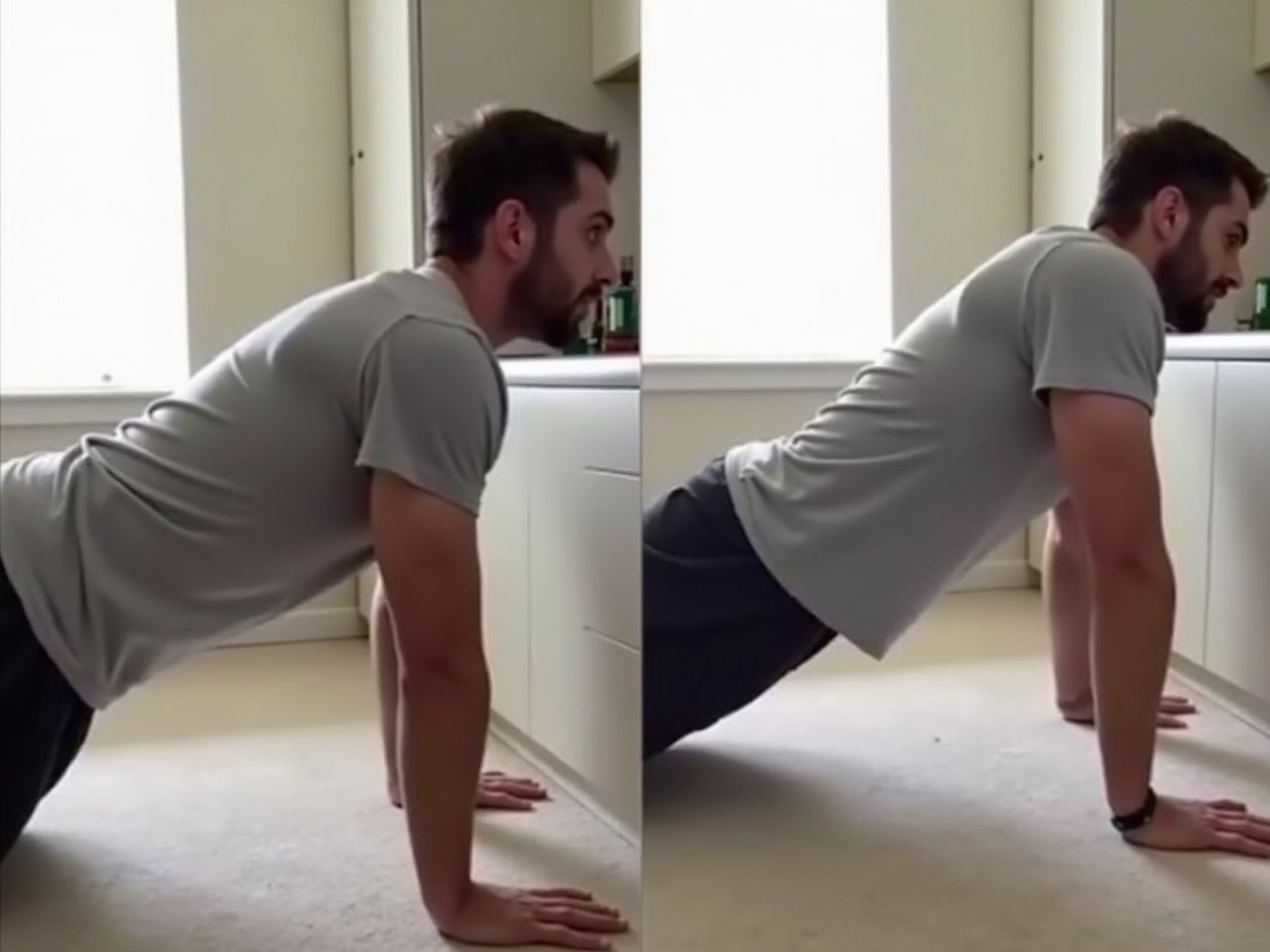
Bodyweight version: incline push-up with hands on a counter. Loaded version: floor push-up, then eventually weighted push-up or bench press.
Pull. You pull resistance toward your body. This trains your back and biceps.
Bodyweight version: doorframe row or inverted row under a sturdy table. Loaded version: dumbbell row, barbell row, or pull-up.
Carry or brace. You stabilize your trunk against an external load. This trains your core, grip, and full-body stability.
Bodyweight version: plank or side plank. Loaded version: farmer’s carry with a backpack in each hand.
These five patterns address all the major muscle groups. If your program hits all five, you are training your whole body. If it misses one, you are building a gap.
That is the core of movement patterns strength training: cover all five and you cover everything (BarBend).
How to Pick the Right Resistance for Your Body
Resistance is anything that makes a movement harder. That can be your bodyweight, a resistance band, a dumbbell, a loaded backpack, or a barbell.
The ACSM’s 2026 guidelines are clear on this: any form of resistance works. Bodyweight training, bands, free weights, machines, they all produce marked benefits when you train consistently and with sufficient effort (ACSM, 2026).
A systematic review and meta-analysis of 21 studies confirmed that low-load resistance training, including bodyweight exercises taken near muscle failure, produces similar muscle growth to high-load training (Schoenfeld et al., 2017). Bodyweight training produces meaningful strength gains for beginners.
If your goal is maximal absolute strength, like deadlifting 400 pounds, external loading will eventually become necessary. For the practical strength most men need, bodyweight work plus a loaded backpack goes a long way.
Here is the practical progression: start with whatever lets you complete 8 to 12 controlled reps where the last two feel hard.
If 8 bodyweight squats feel easy, add a loaded backpack. If 8 backpack squats feel easy, get a pair of adjustable dumbbells. If dumbbells feel easy, you know what comes next.
The tool does not matter as much as the effort. A man doing push-ups to failure in his living room is working harder than a man half-heartedly curling light dumbbells while scrolling his phone.
Progressive Overload: The One Rule That Makes Everything Work
Progressive overload is the engine. Without it, you are exercising but you are not training. Understanding progressive overload for beginners is the single most important concept, and it governs how to get physically stronger over time.
The principle is simple: to get stronger, you must ask your body to do slightly more than it did last time. Your body responds by adapting: rebuilding muscle tissue and upgrading neural pathways to handle the new demand. If you never increase the demand, your body never needs to adapt.
There are six ways to apply progressive overload:
- Add reps. Last week you did 8 push-ups. This week, do 9.
- Add sets. You did 2 sets of squats. Next session, do 3.
- Add load. Your backpack held 10 pounds. Add a water bottle. Now it holds 12.
- Slow the tempo. Take 3 seconds to lower yourself in a squat instead of 1. More time under tension equals more stimulus.
- Increase range of motion. Go deeper in your squat. Touch your chest to the floor in a push-up. Full range of motion recruits more muscle fibers.
- Use a harder variation. Move from incline push-ups to floor push-ups. From bodyweight squats to split squats. From planks to plank shoulder taps.
You do not need to use all six at once. Pick one. Apply it. Record the result.
For strength specifically, the ACSM recommends training with heavier loads, roughly 80% of the most weight you can lift once, for 2 to 3 sets per exercise (ACSM, 2026). For muscle growth, aim for approximately 10 sets per muscle group per week.
As a beginner, do not overthink this. Two to three hard sets per exercise, twice a week, will carry you for months.
The rule: if the numbers are going up, you are getting stronger. If the numbers are flat, check your overload, your recovery, or your effort.
How Often to Train, Eat, and Recover for Strength
Strength is built during recovery, not during training. For effective strength training recovery for beginners, three things matter more than anything: sleep, protein, and rest days.
The workout is the stimulus. The adaptation happens while you sleep and eat.
Training frequency. Two to three full-body sessions per week. Two days is the minimum effective dose. Three is better if you can recover.
More than three is unnecessary for a beginner and increases injury risk. Always leave at least 48 hours between strength sessions. The ACSM’s 2026 guidelines confirm that training all major muscle groups at least twice a week produces marked benefits (ACSM, 2026).
Sleep. Get enough sleep so you wake up rested. Sleep is when your body repairs muscle tissue and restores the systems taxed by training. If you train hard and sleep five hours, you are breaking yourself down without letting yourself rebuild.
Protein. The International Society of Sports Nutrition recommends 1.4 to 2.0 grams of protein per kilogram of body weight per day for exercising individuals, split across 3 to 4 meals with 20 to 40 grams per serving (ISSN, Jager et al., 2017).
For an 80-kilogram man (about 176 pounds), that is 112 to 160 grams of protein per day. Roughly: three meals with a palm-sized portion of meat, fish, or eggs each, plus a protein shake or a container of Greek yogurt.
Overall activity. The CDC recommends at least 150 minutes of moderate-intensity aerobic activity and two days of muscle-strengthening activity per week (CDC). Your two strength sessions satisfy the muscle-strengthening component. Walking, cycling, or anything that gets your heart rate up covers the rest.
Do not overcomplicate nutrition at the start. Eat enough to fuel your training. Prioritize protein. Sleep. Those cover most of what recovery demands for a beginner learning how to get physically stronger.
How to Track Your Strength So You Know It Is Working
You cannot manage what you do not measure. Tracking turns strength training from a feeling into a fact.
Write down five things every session: the date, the exercise, the number of sets, the number of reps, and the load or variation used. Add a notes column for anything relevant: “last rep was slow,” “slept badly,” “right knee felt tight.”
A notebook and a pen work better than an app. You are not checking notifications. You are recording data.
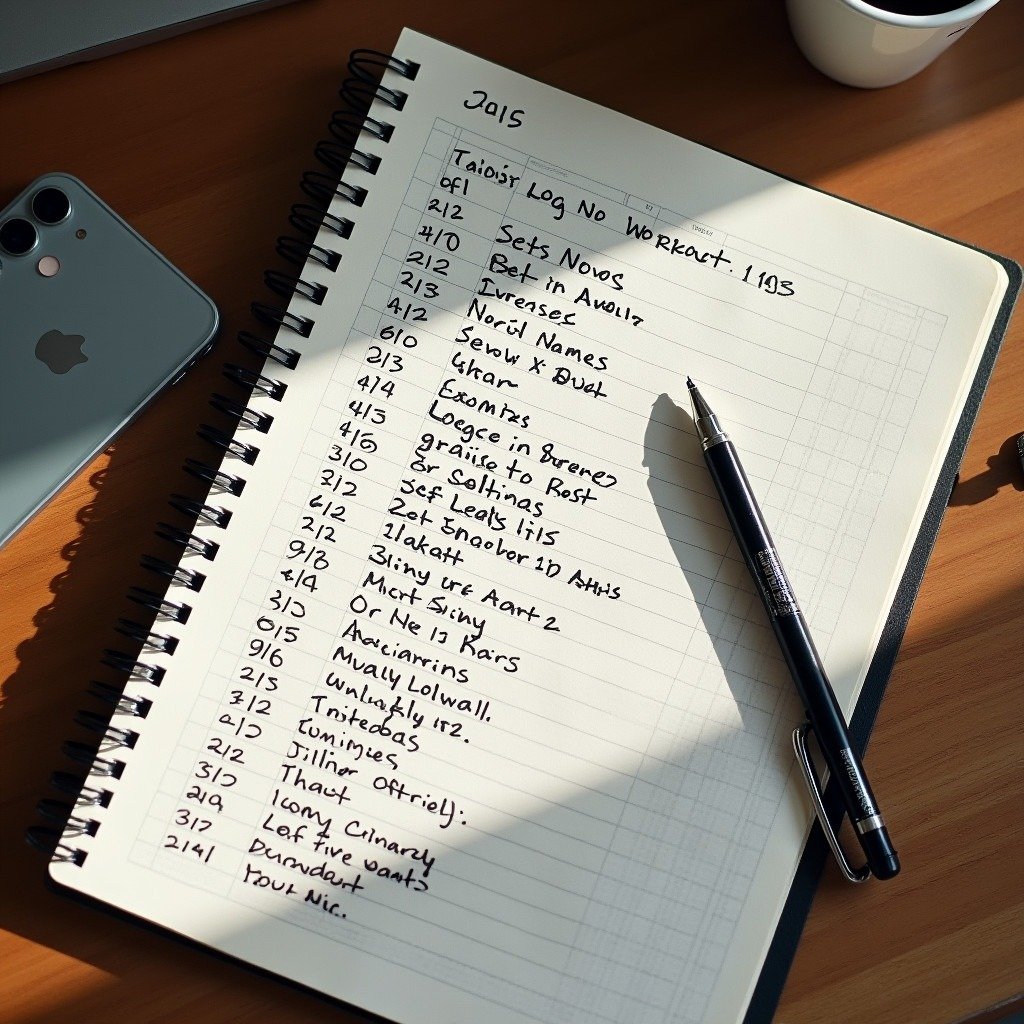
Review your log every two weeks. If your squat went from 3 sets of 8 to 3 sets of 12 in the same variation, you got stronger. If your push-up went from incline to floor, you got stronger. The numbers do not lie.
This is how you know the program is working before the mirror agrees.
Your First Month: A Beginner Strength Template
Here is a two-day full-body beginner strength workout routine that requires no gym membership.
Day 1 (for example, Monday):
- Bodyweight squat: 2 sets of 8-12 reps
- Incline push-up (hands on a counter or table): 2 sets of 8-12 reps
- Loaded-backpack Romanian deadlift: 2 sets of 8-12 reps
- Doorframe row or inverted row under a table: 2 sets of 8-12 reps
- Plank: 2 sets, hold for 20-40 seconds
Day 2 (Thursday, leaving at least 48 hours):
- Same five exercises
- Add one rep to each set where you completed all reps with good form last session
- If you completed all reps easily, add a third set or increase the load
That is it. Five exercises. Two days a week. Track every session. Apply progressive overload every week.
If you have access to a gym and prefer barbells, swap the bodyweight squat for a goblet squat or barbell back squat, the incline push-up for a bench press, and the doorframe row for a dumbbell or barbell row. The template stays the same.
For a shorter session on days you are pressed for time, use this 20 minute strength workout. The point is not the duration. The point is showing up twice a week, forever.
Physical strength does more than change your body. It changes what you believe you are capable of. There is a reason why physical fitness builds discipline across every other area of life.
The first time you do something you could not do a month ago, something shifts. You stop guessing whether you can follow through. You know.
Safety, Pain, and When to Get Help
This article is educational content, not medical advice. Consult a doctor before beginning an exercise program if you have been inactive for more than a year, are significantly overweight, or have a pre-existing medical condition. Sharp or joint pain is a stop signal, not a push-through signal.
Muscle soreness that starts a day or two after training and fades within a few days is normal. It means you gave your muscles a new stimulus. It is not a sign of injury.
Sharp pain, joint pain, or pain that gets worse during a movement is different. Stop immediately. Do not push through it. See a doctor or a physical therapist.
If you have been inactive for more than a year, are significantly overweight, or have a pre-existing medical condition, get clearance from a doctor before starting a strength program. This is not a liability disclaimer. It is practical: you want to build on a foundation that is safe.
Progress steadily. The goal is years of training, not one heavy month followed by an injury.
What to Do Tomorrow Morning
Wake up. Put on shorts and a t-shirt. Clear a space on your floor.
Do five bodyweight squats. Focus on going as low as you can with your chest up and your heels on the ground.
Do five incline push-ups with your hands on a kitchen counter or a sturdy table. Keep your body straight from shoulders to heels.
Hold a plank for 30 seconds. Breathe. If 30 seconds is too long, hold for 20. If 30 seconds is easy, hold for 45.
Write down what you did. Date it. That is your first training entry.
Two days from now, do the same three movements and add one rep or five seconds to each. Then do it again two or three days after that.
You are now strength training. The program is simple. The rule is progressive overload. The only missing piece is you showing up.